

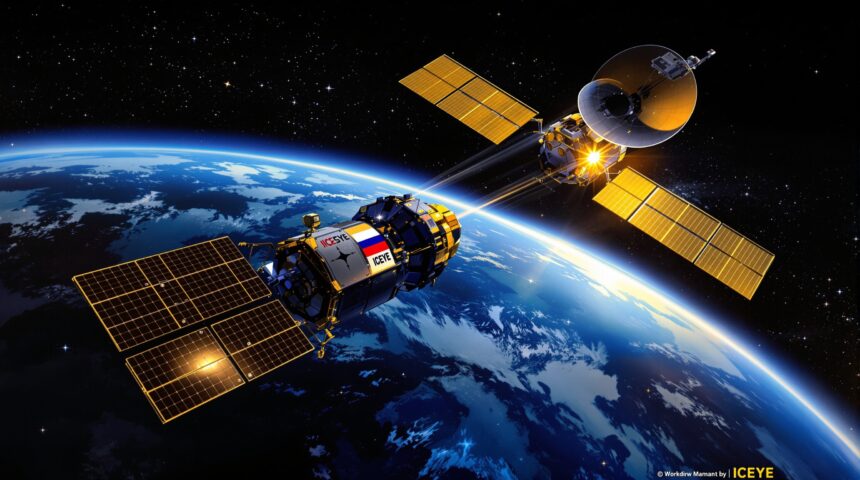
Russian military satellites have sidled up to a commercial radar spy satellite that feeds intelligence to Ukraine, and the orbital dance is raising alarms about a potential strike in space.
Four Kosmos Satellites Close In
Over the past week, four Russian satellites—designated Kosmos 2610 through 2613—executed precise orbit changes to match the path of ICEYE-X36, a Finnish-American radar imaging satellite. The maneuvers were spotted by Greg Gillinger, a retired Air Force space intelligence officer, using open-source tracking data. The Russian spacecraft burned significant fuel to shift their orbital inclinations by less than a degree—a “plane change” that requires as much energy as boosting altitude by over 100 miles.
The four satellites now routinely pass within 500 meters to 22 kilometers of ICEYE-X36, which orbits about 340 miles above Earth. A fifth Russian satellite from the same April launch appears to be performing similar moves to join the formation.
What Russia’s Space Weapons Look Like
US officials believe these Kosmos satellites are part of a covert anti-satellite (ASAT) weapons program—specifically, a co-orbital system designed to approach and potentially disable another spacecraft. Gen. Stephen Whiting, head of US Space Command, recently stated that Russia is “operationalizing” this capability. “Plane matching is the first and most fuel-expensive step to conducting rendezvous proximity operations,” Gillinger wrote. “That capability is not common for typical Earth observation or communications missions.”
This mirrors Russia’s Nivelir program, where similar satellites have stalked US spy satellites belonging to the National Reconnaissance Office. A separate Russian military satellite recently arrived in geosynchronous orbit, 22,000 miles up, prompting the US Space Force to dispatch an inspection satellite for a closer look.
Why This Matters—and What It Doesn’t Change
Targeting a single ICEYE satellite wouldn’t cripple Ukraine’s access to radar imagery. ICEYE operates dozens of similar spacecraft, and unlike optical spy satellites, their radars see through clouds and darkness at resolutions as fine as 16 centimeters—roughly the size of a grapefruit. But the message is clear: Russia is rehearsing the ability to pick off high-value assets in orbit, one at a time.
The real takeaway isn’t about Ukraine’s imagery supply—it’s about the normalization of space as a contested domain. If Russia is willing to shadow a commercial satellite providing intelligence to an adversary, the next target could be a US or allied military satellite. The era of space as a sanctuary is over; we’re now watching the first moves of a conflict that hasn’t yet been declared.
—
Originally reported by Ars Technica and Tom’s Hardware. Adapted and republished with editorial context for SpaceSecurityNews.*