Space Security News
  • Home
  • News
    A large featureless communications satellite above the night side of Earth with debris fragments streaking past on cyan trajectories

    Musk warns an armed Starlink invites Russian anti-satellite strikes

    October 26, 2026
    A cluster of white parabolic satellite tracking dishes on a coastal hilltop at dusk with a gold radio beam rising toward a small satellite

    Washington gags New Zealand from describing its own tracking hub

    October 26, 2026
    A dense mega-constellation of satellites in orbital shells above a night side Earth with a gold data beam rising from one satellite platform

    SpaceX gets first enhanced view of the military’s orbital catalog

    October 26, 2026
    Twin-engine airliner above a night cloud deck with gold signal rings and a cyan aurora on the horizon

    Safran puts a military-grade navigation core on the A220

    October 24, 2026
  • Features
    Empty tiered conference hall with gold geometric ceiling and tall windows overlooking a deep blue twilight city skyline

    China pushes a space arms race paper as Washington stays quiet

    October 24, 2026
    Ground-based laser observatory dome firing a gold beam at a reconnaissance satellite over a night mountain range

    Germany opens a market hunt for lasers that can blind satellites

    October 24, 2026
    An uncrewed patrol boat with a radar mast navigating coastal water at blue hour

    A robot boat finds its way home with the satellites switched off

    October 23, 2026
    A secure aerospace campus at night beneath a gold network of connected nodes

    A clearance pathway opens for commercial firms chasing classified work

    October 23, 2026
  • Spotlight
  • Events
  • About Us
    • Mission
    • Services
    • Contact Us
Reading: Europe rearms: battle management, counter-uas, and real AI at the edge
Share
Search
  • Trending:
  • Alliances
  • Cislunar
  • Commercial
  • Communications
  • Cyber
  • Debris
  • Defense
  • Deterrence
  • Intelligence
  • Launch
  • Strategy
  • Surveillance
  • Missile
  • Navigation
  • War
Font ResizerAa
Space Security NewsSpace Security News
  • Home
  • News
  • Features
  • Spotlight
  • Events
  • About Us
Search
  • Home
  • News
  • Features
  • Spotlight
  • Events
  • About Us
    • Mission
    • Services
    • Contact Us
Follow US
© 2026 Space Security News. All Rights Reserved.
Emerging Threats & Tech

Europe rearms: battle management, counter-uas, and real AI at the edge

By
SSN Staff
Last updated: June 16, 2026
4 Min Read
Share

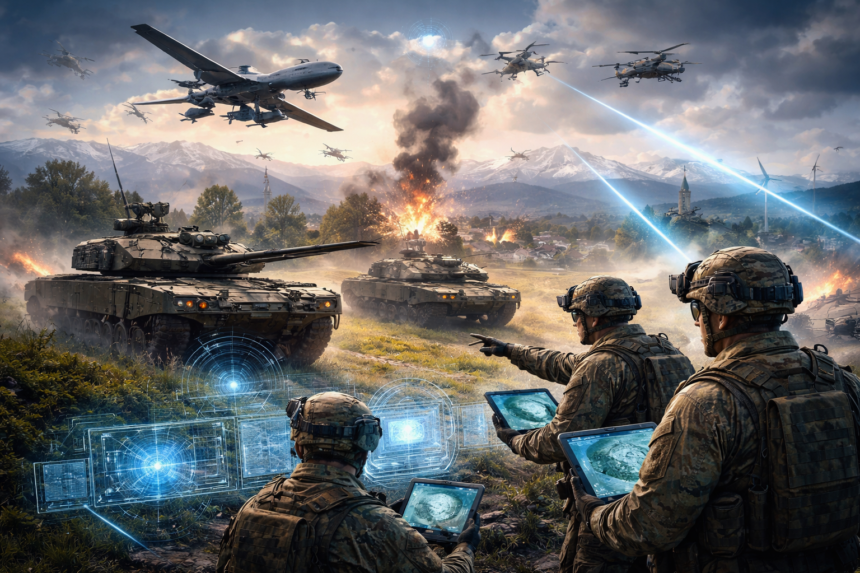
European defense modernization is accelerating at an unprecedented pace, driven by NATO spending pressure and a rapidly evolving threat landscape, with investment surging into battle management systems, counter-unmanned aircraft systems (C-UAS), and artificial intelligence deployed at the tactical edge.

Contents
  • Battle Management Systems Move from Differentiator to Table Stakes
  • Layered C-UAS Architectures Require a Mosaic of Sensors
  • Pushing AI to the Edge for Real-Time Tactical Advantage
  • What This Means for European Defense

According to Bill Guyan, Senior Vice President of Business Development and President of International Business at Leonardo DRS, decades of deferred modernization have left many European forces vulnerable. “The combination of the administration’s pressure and attention, and also because of the change in the threat environment, we’re seeing dramatic spending increases and modernization of forces across Europe,” Guyan said. Key growth areas include air and missile defense, C-UAS, and next-generation command and control (C2), though industrial capacity constraints may delay procurement.

Battle Management Systems Move from Differentiator to Table Stakes

Battle management systems have evolved from simple GPS-based force tracking to sophisticated platforms capable of sharing text, graphics, and operational orders. “Battle Management System capabilities used to be a real differentiator. Now they’ve become table stakes for modern armies,” Guyan noted. The proliferation of Class 1 drones, which overwhelm traditional integrated air-and-missile-defense systems, has made a common operational picture (COP) essential for every soldier and vehicle.

A battle management system enables the rapid dissemination of threat data from sensors across the force. This COP is critical for countering the low-cost, high-volume drone threat, which can be as deadly as advanced systems if it finds its mark.

Layered C-UAS Architectures Require a Mosaic of Sensors

There is no single solution for the diverse drone threat, which ranges in speed, altitude, and payload. “Multiple types of detection and defeat mechanisms have to be employed in an integrated, overlapping way so they can reinforce one another and nothing can slip through,” Guyan explained. The enemy will target high-value, exquisite sensors, making resilience through layered defenses paramount.

Leonardo DRS advocates for a mesh of lower-cost, mobile, and transportable radars that can serve as gap fillers or, in extremis, be networked to provide a meaningful COP. “The quantity of those radars provides a quality unto itself because it provides built-in resiliency,” Guyan said, citing operational deployments in Israel and Ukraine where such systems are saving lives.

Pushing AI to the Edge for Real-Time Tactical Advantage

While much AI work occurs at the headquarters and cloud level, Leonardo DRS argues for pushing artificial intelligence down to the platform level. The U.S. Army’s Next Generation C2 (NGC2) exercises at the 4th and 25th Infantry Divisions are demonstrating how AI can be enabled on the battlefield. “They’re linking the problem of how to get AI on the battlefield, how to set up the data management layer, and how to transfer data across different systems to identify a target with one system and engage it with another,” Guyan said.

This shift toward real-time, edge-based AI processing allows commanders to act on sensor data faster than ever before, turning raw information into decisive action.

What This Means for European Defense

The convergence of battle management, layered C-UAS architectures, and edge AI signals a fundamental shift in how European forces will fight. The next decisive edge will not come from more missiles but from better data, smarter sensors, and AI pushed forward. For defense planners, the imperative is clear: invest in resilient, networked systems that can survive first strikes and maintain a shared, actionable picture of the battlefield.

— Originally reported by Breaking Def.. Adapted and republished with editorial context for SpaceSecurityNews.


Sign Up For Daily Newsletter

Be keep up! Get the latest breaking news delivered straight to your inbox.
By signing up, you agree to our Terms of Use and acknowledge the data practices in our Privacy Policy. You may unsubscribe at any time.
Share This Article
Facebook Email Copy Link Print

LATEST NEWS

A large featureless communications satellite above the night side of Earth with debris fragments streaking past on cyan trajectories

Musk warns an armed Starlink invites Russian anti-satellite strikes

Emerging Threats & TechNews
October 26, 2026
A cluster of white parabolic satellite tracking dishes on a coastal hilltop at dusk with a gold radio beam rising toward a small satellite

Washington gags New Zealand from describing its own tracking hub

US Space Command has told the New Zealand Defence Force it cannot say what its…

October 26, 2026
A dense mega-constellation of satellites in orbital shells above a night side Earth with a gold data beam rising from one satellite platform

SpaceX gets first enhanced view of the military’s orbital catalog

A Space Force data trade has put the government's most precise collision picture in the…

October 26, 2026
Twin-engine airliner above a night cloud deck with gold signal rings and a cyan aurora on the horizon

Safran puts a military-grade navigation core on the A220

Airbus has picked an inertial system hardened on fighter jets and helicopters to keep its…

October 24, 2026

YOU MAY ALSO LIKE

Space Force delivers over $500 million in rapid technology awards

The Space Force awarded over $500 million in rapid prototyping contracts to commercial companies developing next-generation space technologies.

Emerging Threats & TechNewsSatellite Security
July 18, 2026

Russian satellites move within striking distance of ICEYE radar satellite supplying intelligence to Ukraine

Russian military satellites have sidled up to a commercial radar spy satellite that feeds intelligence to Ukraine, and the orbital…

Emerging Threats & TechSatellite SecuritySpotlight
May 25, 2026

Beijing’s classified duo starts signal hunts from an untried orbit

China's TJS-27 pair enters a signal-hunting orbit for the first time as a new Tianlian relay joins the fleet.

Emerging Threats & Tech
August 2, 2026

Chinese startup scores state-backed cash for satellite signal tracking

Tianjin's StarRF closes a state-backed Pre-A+ round for a low Earth orbit constellation that detects and geolocates radio emissions.

Emerging Threats & Tech
August 23, 2026

Breaking developments in space and cybersecurity, decoded for the modern defense and technology landscape.

Follow us: 

  • News
  • Features
  • Spotlight
  • Events
  • About Us
  • Mission
  • Services
  • Contact Us
Copyright © 2026 Space Security News. All Rights Reserved.
Privacy Policy | Legal
Welcome Back!

Sign in to your account

Username or Email Address
Password

Lost your password?