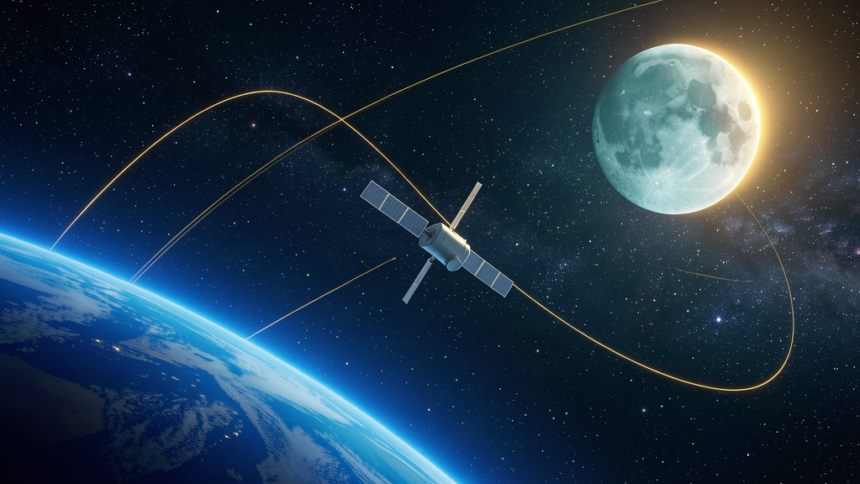
The chairman of the Joint Chiefs of Staff has added the Moon to the list of places American troops are expected to fight.
Speaking at the Air, Space and Cyber conference in National Harbor, Maryland, on Sept. 16, Gen. Dan Caine said the joint force has to change now so that it is ready to fight, endure and win in contested environments that stretch from the ocean floor out to cislunar space.
Why the Moon matters to planners
Cislunar space is the volume around and beyond the Moon. NASA’s Artemis effort, commercial landers and a growing number of military experiments are all pushing activity outward. Once relays, sensors and crews operate there, the same counterspace problems that already trouble geostationary orbit follow them outward: no terrain to hide behind, long communication delays, and very few watchers.
Those remarks landed two days after Air Force Secretary Troy Meink said on the record that the United States keeps space control weapons in orbit, closing out years of official ambiguity about the military’s counterspace arsenal.
Practice before posture
Caine framed the shift as a training challenge more than a hardware one. Forces that expect to operate beyond Earth orbit need doctrine, exercise ranges and command arrangements built for distance and delay, and none of those currently reach much past low Earth orbit.
China and Russia have both described cislunar activity as a national priority. Analysts have warned for years that the domain has no agreed rules of behavior and no traffic coordination.
Caine offered no timeline, budget line or named program. The remark signals intent. Whether it becomes doctrine depends on whether the services write requirements around it.