

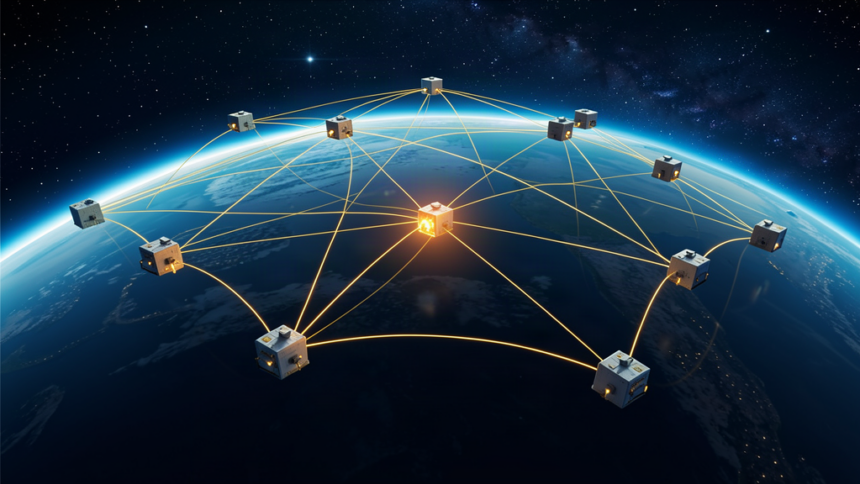
Every spoofing attempt was caught during simulation by a zero-trust security framework built for satellite networks, researchers report in Scientific Reports. The goal is stubborn: locking down the non-terrestrial networks meant to carry 5G coverage across oceans, deserts and disaster zones.
The obstacle is structural. A cell tower bolted to the ground lets a device authenticate once at the perimeter, after which it is trusted. Orbital nodes race across the sky at kilometres per second and hand connections off continuously, so the castle-and-moat approach fits badly.
A machine-learning engine sits at the heart of the design, judging trustworthiness from behavior. Into an isolation forest algorithm, an unsupervised anomaly-detection technique, the system streams network signal data. Observations that random partitioning isolates in fewer splits than normal traffic stand out as suspicious, keeping the method light enough for streaming telemetry.
Spoofing rates as the attack class that matters most. Traffic across an entire constellation can be intercepted or redirected by an adversary who convincingly impersonates a legitimate node. Against simulated spoofing attempts the framework scored 100 percent success, with attack recall of 1.0000 and zero false negatives.
Kinematic physics provides the strongest trust signals, the authors’ importance analysis found: velocity deviation, GPS distance and Doppler shift. Orbital mechanics dictate these quantities, so an attacker cannot fake them easily.
Continuous authentication brings its own burden. Signalling load and re-authentication latency balloon when a fresh cryptographic challenge fires on every handover. Around 1,600 milliseconds is where traditional handover authentication peaks, an eternity for sessions riding fast satellite transitions.
A proactive cryptographic cache paired with the engine cut signalling overhead to 0.75 percent, well inside the authors’ 8 percent ceiling for deployment. Latency dropped to 7.2 milliseconds under warm-cache conditions while 99.5 percent session continuity held.
A proof of concept, the researchers caution.



