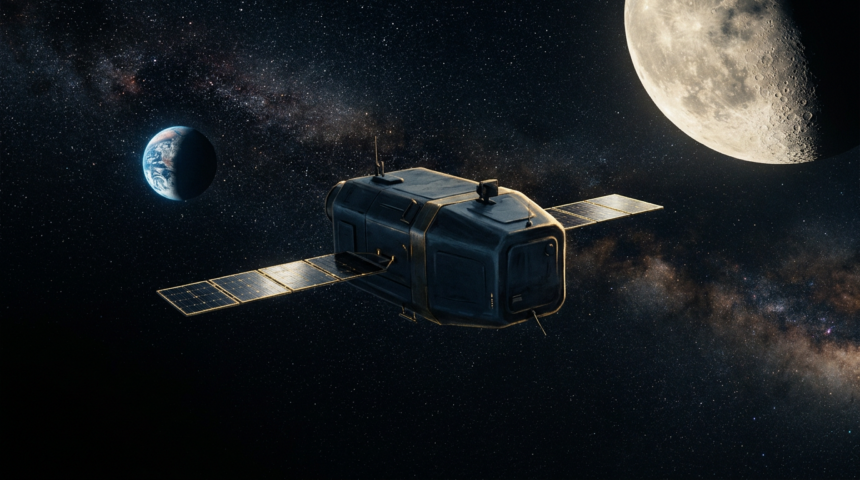
The two requests for information will seek commercially available spacecraft and artificial intelligence software for missions beyond geostationary orbit, with hardware on orbit before the end of fiscal 2029.
Maj. Gen. Stephen Purdy, the Space Force’s portfolio acquisition executive for advanced programs, described the turnaround at Space Industry Days in Los Angeles this week. Earlier in the year, he said, he was told to stop talking about the region. Now the defense secretary and the chairman of the Joint Chiefs both call it a warfighting domain.
Purdy’s Cislunar Coordination Office, stood up in May, is meant to give industry a signal it never had. The first solicitation covers space domain awareness and positioning, navigation and timing.
No research contracts on offer
The service will not fund development. Purdy wants non-developmental hardware with test evidence behind it, software that needs little work, and ground systems designed as part of the network rather than appended to it.
A second request targets autonomous operations, which matter because the volume between Earth and the Moon is hard to reach and slower to correct. Spacecraft there must detect their own failures, parse sensor data and re-plan without a ground crew watching in real time.
The stated driver is China. Purdy pointed to a Chinese project that placed roughly 30 cubesats into a highly elliptical orbit near an Earth-Moon Lagrange point and into a circular lunar orbit. Beijing calls it science. Several analysts told Breaking Defense it looks like cislunar surveillance.
The office is also drafting a roadmap covering lunar time, domain awareness and communications, and has built a prioritized list of small unfunded shortfalls. Purdy would not put a figure on the total.