
Federal agencies have until 2030 to retire the cryptography a quantum computer would break. Space Force officers say the satellites they are building now will still be flying when that clock runs out.
Lt. Col. Vinny Pande, a materiel leader at SpaceWERX, told the MilSat Symposium that government work is tethered to NSA Type 1 encryption standards, and the money to migrate sits elsewhere. “We don’t quite have the mandate on the Space Force side to put money behind it,” he said.
A deadline that arrives too late
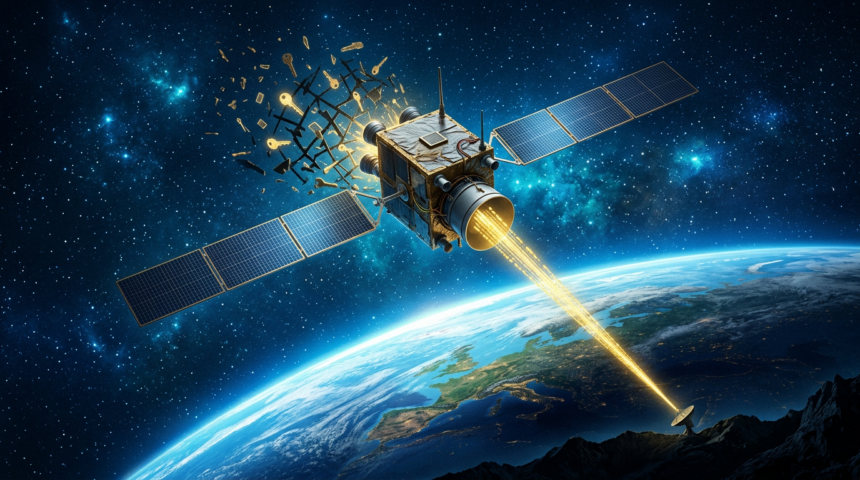
Panelists at Silicon Valley Space Week argued the 2030 target is already the wrong yardstick. Spacecraft operate for a decade or more, and the post-quantum standards from NIST are published and ready to implement. Traffic encrypted today can be recorded and opened later, once the hardware catches up.
“Have to be implemented today, not in 2030,” said David Gelerman, chief executive of SpaceBridge, pointing to post-quantum key exchange and authentication as the starting pair.
Where the attack actually lands
Sanket Kamble, co-founder of threat-simulation firm OrbitSec, described a narrower path than most defenders picture. An adversary does not need to subvert a satellite’s AI payload to end a mission. Undermining the trust layer around it is sufficient.
The panel drew together Kratos, Dell Technologies Federal and Space Systems Command’s Space Systems Integration Office, along with the SpaceWERX venture arm that places roughly $500M to $700M a year of non-dilutive capital into startups.
Companies already selling post-quantum capability have a customer base outside the defense market; military programs cannot move until standards and funding authorities catch up.
For satellite operators, the practical exposure is not the 2030 date. It is the telemetry, commands and payload data moving through links today that will still be sensitive when a quantum machine can replay them.