
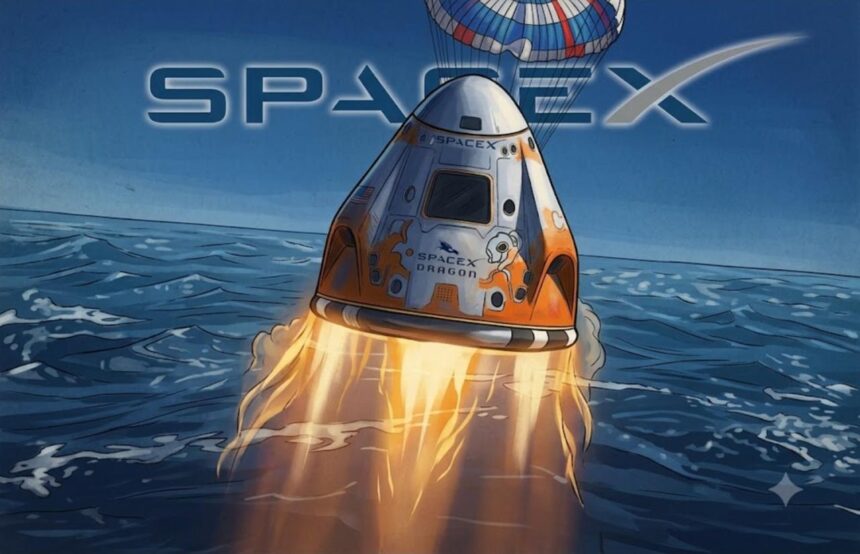
Bloomberg first broke the story last July: SpaceX was quietly developing a capsule program for in-space manufacturing, code-named Starfall. Now, newly released FAA filings confirm the scale of the ambition — and it goes well beyond manufacturing.
The FAA on May 15 issued an environmental assessment and record of decision approving two test reentries of SpaceX’s Starfall capsules, concluding no significant environmental impacts. The agency did not publicize the decision until a May 29 “FAA Space Update,” giving the documents a two-week quiet window before public scrutiny.
A Capsule with Two Missions
The FAA filings paint Starfall as a dual-purpose system. On one hand, it is designed to support in-space manufacturing by returning products from orbit. On the other, SpaceX explicitly frames it as a point-to-point cargo delivery vehicle — cargo being the operative word, as in time-sensitive payloads moving through space on rapid timelines.
From a security perspective, the latter mission is the more interesting one. The record of decision states SpaceX’s proposal aims to “enable point-to-point delivery of critical cargo through space on rapid timelines” and “create a self-sustaining commercial in-space manufacturing market.” Rapid suborbital cargo delivery has obvious military logistics applications, a fact that has not been lost on the U.S. Space Force and Transportation Command, both of which have explored commercial rapid space lift concepts.
Starfall capsules would launch on Falcon 9 or Starship and reenter over the Pacific Ocean roughly 1,300 kilometers off the coasts of California and Mexico. The two approved tests involve either orbital or direct suborbital trajectories to the landing zone.
Built for Scale
Technically, Starfall is a relatively small vehicle. The capsule is disk-shaped, 0.75 meters tall and 3.1 meters in diameter at the top. It uses cold-gas attitude control thrusters and cannot deorbit on its own — meaning it depends entirely on its launch vehicle for orbital insertion and timing.
The vehicle breaks into two main components on splashdown: a 1,400-kilogram aluminum top plate partially wrapped in thermal protection, and a 700-kilogram carbon-fiber heat shield that also houses nitrogen gas bottles for the thrusters. A single main parachute, with pilot and drogue chutes, handles descent. SpaceX will recover all elements by boat.
What makes this project worth watching is the production plan behind it. The environmental assessment covers only two test flights and does not specify dates. But supporting documents from contractor KBR note that SpaceX “plans to develop a mass producible reentry vehicle” capable of carrying up to 1,000 kilograms in a 2.5-by-1.5-by-0.5-meter internal volume. Mass producible reentry vehicles at that payload class would be a first — and a potential game changer for defense logistics, pharmaceutical manufacturing return, and sensitive hardware recovery.
Eating Their Lunch
Starfall also puts SpaceX in direct competition with the companies that rely on it for rideshare launches — an awkward dynamic that is becoming increasingly common in the space industry.
Varda Space Industries has flown six W-series missions on SpaceX, returning capsules to Utah and Australia for hypersonics testing and microgravity research. Inversion flew its Ray spacecraft on a 2025 SpaceX rideshare but experienced technical issues that prevented reentry. Atmos Space Cargo, Catalyx Space, Lux Aeterna, and Reditus Space are all planning reentry vehicles of their own — almost all of them dependent on SpaceX for launch.
If Starfall reaches production scale, those companies could find themselves competing for customers against their own launch provider. That’s a concentration-of-supply risk that has drawn attention from both regulators and defense planners who prefer multiple independent supply chains.
For now, the FAA filings confirm that Starfall is real, funded, and moving toward flight tests. How the competitive landscape shakes out — and whether the U.S. military sees Starfall as a logistics asset or a single-point-of-failure risk — will be the story to watch.
— Originally reported by SpaceNews. Adapted and republished with editorial context for SpaceSecurityNews.