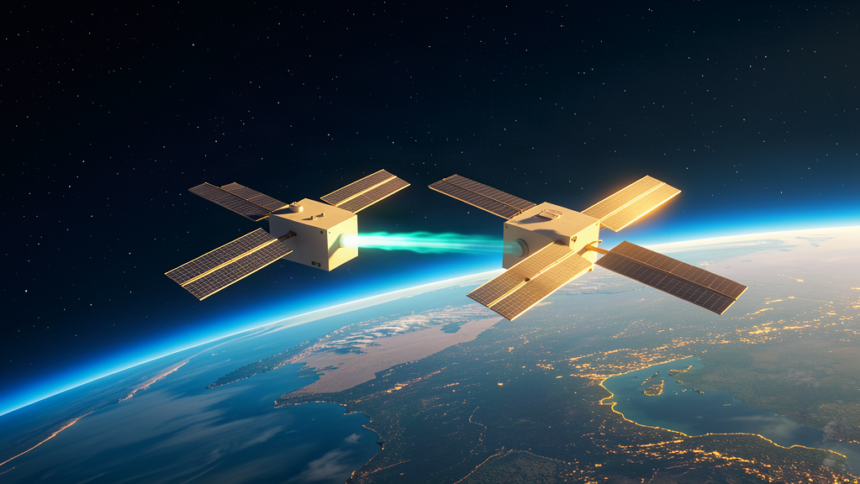
Ground telescopes can see what sits in geostationary orbit, but they cannot say much about what a spacecraft up there is doing. Closing that gap is the goal of a French partnership that pairs a small satellite platform with a rendezvous payload.
HEMERIA would build the spacecraft using heritage from its YODA programme. Astroscale France would supply the equipment that lets a small inspector close in on another operator’s satellite and work alongside it. Aimed at defence and sovereign buyers, the microsatellite route avoids the bespoke programmes that run into the hundreds of millions of euros, the companies said.
A belt that matters
Geostationary orbit carries communications, weather and national security satellites, and the partners describe it as an increasingly contested place. Their argument is that detection from the ground is not the same as understanding, and that some objects have to be inspected at close range before an operator can judge their condition or behaviour.
Astroscale points to ADRAS-J, its mission that approached and characterised an unprepared piece of orbital debris, as evidence that its rendezvous technology works against objects never built to cooperate.
Philippe Blatt, who leads Astroscale France, said visibility alone is no longer enough for governments and defence operators that need to understand activity around their own assets. HEMERIA chairman Nicolas Multan said the ambition is a sovereign capability built in France and a product for allied nations.