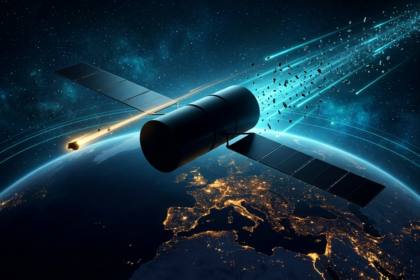


Tokyo’s record defense budget request quietly includes a satellite that does its own surveillance processing in orbit and feeds targeting data straight to weapons. The Ministry of Defense awarded the work to NTT Data on Jan. 8 and confirmed it in a Feb. 13 release, but the program drew public attention only last week, when Nikkei Asia reported that the tactical AI satellite is included in the ¥8.89T ($55.6B) fiscal 2027 budget request submitted Aug. 31, the largest defense appropriation in Japan’s postwar history.
The design is a bet against latency. The traditional loop beams raw data to a ground station, waits for analysts, then moves intelligence up the chain of command. Japan’s Ministry of Defense argues that relay costs too much time against hypersonic weapons, which can cross more than 500 kilometers in the five minutes such a chain might take. Its answer moves processing onto the satellite and connects the output straight to what the ministry calls shooters, cutting the ground station out of the intelligence-to-strike loop.
What stays unresolved is authority. Japanese policy on human control of autonomous weapons has not been applied to this program, and neither the ministry nor NTT Data has said who authorizes a strike before a weapon leaves its platform.
The satellite rides inside a budget that puts AI at the center of Japan’s command structure, pairing American technology with domestic models. For Tokyo, the shift is architectural as much as financial: intelligence analysis moves into orbit, and the question of who decides moves with it.