
Rocket Lab launched a spacecraft for the U.S. Space Force on June 19 as part of the Victus Haze exercise, a military demonstration designed to validate rapid identification and characterization of orbital threats under operationally realistic conditions.
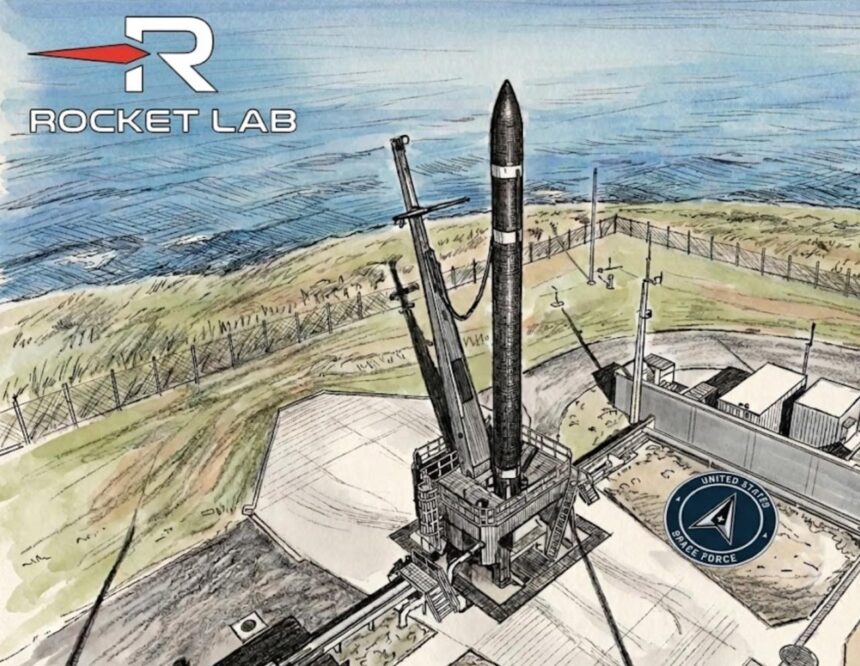
The Electron rocket lifted off from Rocket Lab’s Mahia, New Zealand, facility, carrying the “Victus Haze Puma” satellite into sun-synchronous orbit. The spacecraft is one of two vehicles participating in the mission, funded under a $32 million contract awarded by the Space Force in 2024.
Rendezvous and Proximity Operations in Focus
Following launch, the satellite entered a commissioning phase before initiating rendezvous and proximity operations (RPO) with a second spacecraft operated by Colorado-based startup True Anomaly. Space Systems Command confirmed that on-orbit checkout and vehicle commissioning will precede a series of dynamic engagement scenarios.
“During these operations, the teams operating both the Rocket Lab and the True Anomaly space vehicles will conduct a variety of scenarios, demonstrating space domain awareness and characterization capabilities,” the command stated on June 22. The exercise marks the fourth demonstration under the Space Force’s Tactically Responsive Space (TacRS) program.
Building on Rapid Launch Heritage
Victus Haze expands on the 2023 Victus Nox demonstration, which proved a satellite could launch within 27 hours of receiving an order. While that mission emphasized launch speed, Victus Haze adds the requirement for rapid deployment of spacecraft capable of maneuvering, inspecting, and characterizing objects in orbit.
The broader objective is to transition responsive launch from a proof-of-concept into an operational military capability. Space Force officials have warned that future conflicts may demand satellite replacement, sensor deployment, or orbital threat investigation on timelines of days rather than months.
Operational Milestones and Commercial Integration
Under the Victus Haze architecture, Rocket Lab and True Anomaly provide separate maneuvering spacecraft. Rocket Lab’s vehicle will interact with True Anomaly’s Jackal-004, which launched May 3 aboard a SpaceX Falcon 9 rideshare mission. True Anomaly received a $30 million contract for its role.
Rocket Lab achieved several key benchmarks during the exercise. After receiving the formal notice-to-launch order from the Space Force’s Space Safari program office, the company launched its Electron rocket within 16 hours and 42 minutes—beating the 24-hour requirement. The guidance, navigation, and control team calculated a final trajectory to a previously undisclosed orbit in roughly four hours, updating flight software and coordinating ground stations ahead of liftoff.
Once in orbit, Rocket Lab completed spacecraft commissioning in 37 hours and 36 minutes, enabling orbital maneuvers more than 34 hours ahead of the 72-hour operational deadline. “Victus Haze set out to demonstrate our ability to respond to irresponsible behavior on orbit under operationally realistic conditions, and we are doing just that,” said Col. Bryon McClain, acting Space Force portfolio acquisition executive for Space Combat Power.
True Anomaly confirmed that its Jackal spacecraft is “fully operational and ready to execute rendezvous and proximity operations.”
What This Means for Responsive Space
Victus Haze signals a decisive shift from theoretical rapid-response concepts to proven, commercially integrated capabilities. As the Space Force continues to compress timelines from months to hours, the demonstration validates that maneuvering, characterization, and threat response can be executed on tactically relevant schedules—laying the groundwork for an operational responsive space architecture.
— Originally reported by SpaceNews. Adapted and republished with editorial context for SpaceSecurityNews.