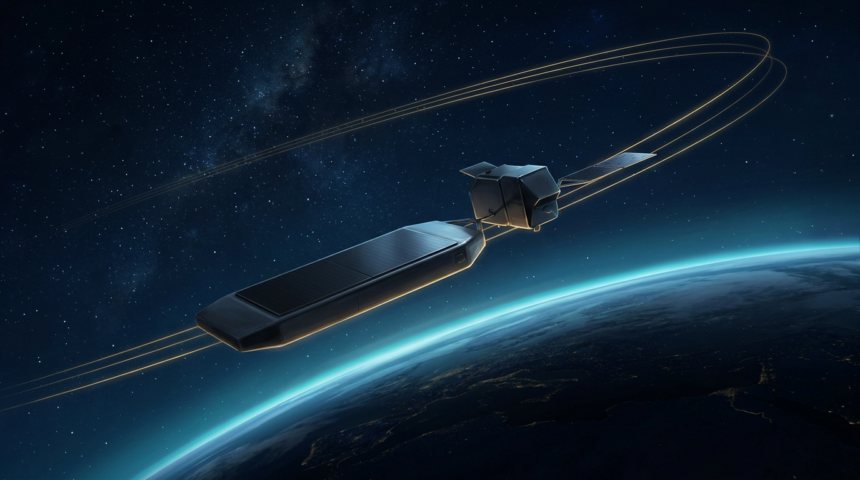
Two weeks of Russian maneuvering ended with a military inspector flying in formation alongside a Western radar satellite. Independent trackers put Cosmos 2612 within a few hundred meters of ICEYE-X36 during a pass at about 01:35 UTC on October 18.
How the chase was built
According to Integrity ISR and CSIS, Cosmos 2612 began moving on September 30, lifting its orbit roughly 46.5 kilometers so natural drift would slide it into the radar spacecraft’s plane. A second burn on October 12 settled it back near 555 kilometers.
Why the tracker alarm matters
Marco Langbroek reported the gap may have closed to a few hundred meters, though public tracking data is too imprecise for a firm figure. Jonathan McDowell had already logged Cosmos 2612 holding station within 5 kilometers a day earlier, calling it the first rendezvous between two active satellites in low Earth orbit without the owner’s approval. Neither found signs ICEYE-X36 was struck or shoved.
ICEYE-X36 weighs about 90 kilograms and last made a detectable maneuver in late June, so its room to dodge is limited. Only ICEYE can say whether the radar craft still works normally; the company has said nothing publicly and has not identified it as one dedicated to Ukraine.
Why it matters beyond one satellite
Matching another operator’s plane is cheap: a small burn buys weeks of drift and repeated passes at near-zero closing speed. Close inspection needs no anti-satellite weapon, and commercial radar imagery now sits alongside military reconnaissance. Cosmos 2612 belongs to a group of six spacecraft, Cosmos 2609 through 2614, launched from Plesetsk in April. Five settled near the same Western radar craft in May, and CSIS, citing COMSPOC, pegged that pass at 2.5 kilometers.
The difference this time is persistence. Earlier approaches ended with the Russians drifting away.