Military satellites have long been built as single-use assets. Once the tank runs dry, a spacecraft with healthy payloads, solar arrays and clocks turns into a drifting liability. Space Systems Command now has set dates for testing a way around that problem.
Two commercial servicing demonstrations will fly in 2027 under the command’s Space Mobility and Logistics portfolio. Col. Scott Carstetter, who directs servicing, mobility and logistics at SSC, laid out the plans during an industry webinar on Sept. 23.
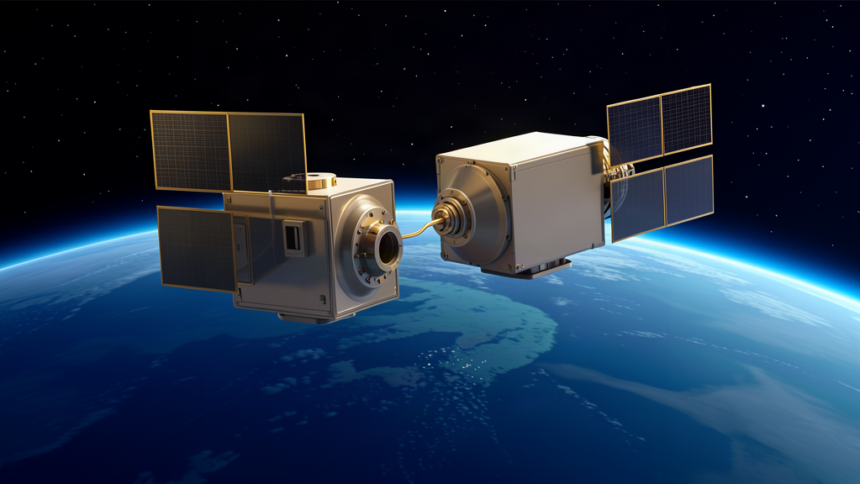
Astroscale U.S. will send a servicer to geosynchronous orbit, dock with a military satellite and transfer storable propellant into it. The vehicle then moves to a commercial fuel depot in the same belt to refill its own tanks, a second leg that tests whether one spacecraft can support repeated servicing runs rather than a single docking.
Starfish Space will fly a different profile with its Otter tug. The autonomous vehicle is to perform rendezvous and proximity operations with several national security satellites, docking to change their inclinations and shift them into new orbital slots, then separating to reach the next client.
Both missions rely on standardized docking fixtures and robotics, the interfaces the Space Force needs before it can buy servicing on a routine basis. SSC also wants cost data, to learn when refueling or repositioning a satellite is cheaper than launching a replacement.
The command describes the work as a step toward dynamic space operations, where satellites maneuver out of harm’s way or move to cover a new region instead of holding a fixed path for years.
That agility has a second edge. A close approach looks the same whether a servicer is delivering fuel or preparing to disable a spacecraft, which is why analysts treat servicing programs as both a resilience tool and a counterspace capability.