

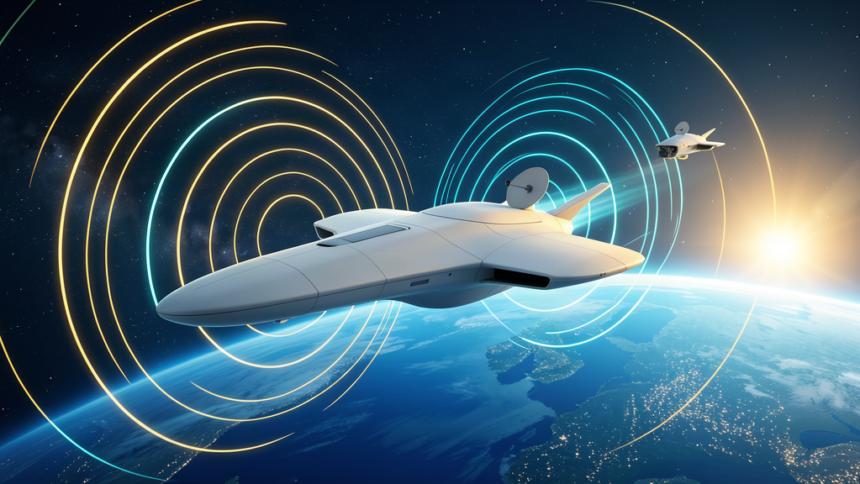
Two startups plan to move spectrum monitoring from ground antennas onto spacecraft that can maneuver, giving satellites a direct read on jamming and interference around them.
Rebel already sells this capability as a ground service: hardware and software linked to antennas at independent satellite teleport companies, where incoming radio signals are analyzed to identify and characterize interference and jamming, including attempts to locate the transmitter. Portal, for its part, builds spacecraft designed to maneuver more than traditional satellites.
Marshall described two possible setups: a dedicated Rebel payload, or the technology embedded as a standard onboard function that keeps Portal spacecraft aware of the radio-frequency environment during any mission. She said putting sensing closer to the spacecraft gives operators an immediate picture of what is affecting a communications link rather than relying on ground observations.
Attempted jamming, suspicious commands and other unusual electromagnetic activity are all things onboard sensing could flag for military spacecraft in contested regions, Marshall said. One concept under discussion is a spectrum warfare payload that goes beyond analytics to respond, defend or mitigate a threat.
Thornburg wants that awareness woven into the vehicle itself, so a spacecraft that maneuvers toward another object or into a new orbital region reads the local radio-frequency environment without waiting for ground-based sensors. The data could also feed space domain awareness, adding electromagnetic information to optical tracking.
The pair plans ground integration testing in a hardware-in-the-loop setup before flight, with Thornburg targeting no earlier than 2027. Portal’s first hardware flew in March on SpaceX’s Transporter-16, and its roughly 300-kilogram Starburst vehicle is set to launch in October on Bandwagon-5, carrying rendezvous cameras, a superconducting magnet payload and debris-protection tiles from Atomic-6.