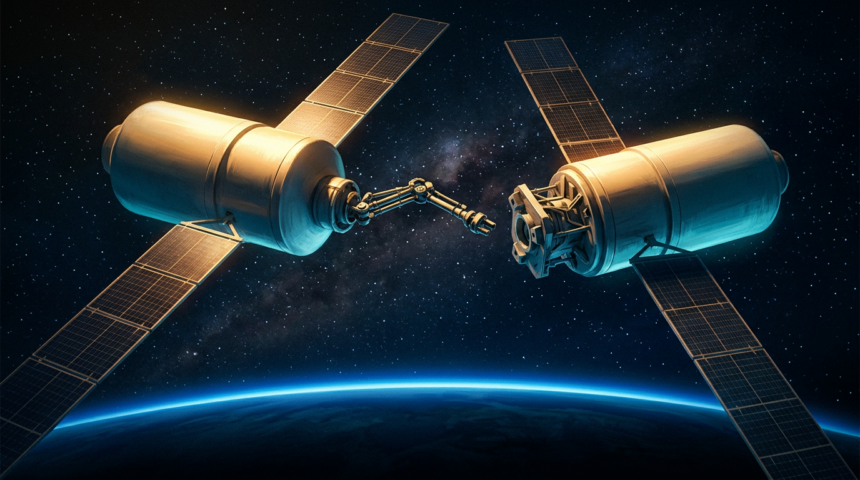
The United States is about to put refuelable satellites in geostationary orbit that cannot top each other up. Northrop Grumman and Sierra Space picked different docking hardware, and neither plug fits the other.
Sierra Space’s Erik Daehler described the standoff at Silicon Valley Space Week’s MilSat Symposium. Both companies have fully refuelable spacecraft heading to orbit, he said, and the industry settled on different interfaces.
A standard exists and nobody has to use it
A common interface payload standard is already on the books, according to Boeing’s Owen Cupp, who works in engineering and technology innovation for mission systems. The problem is acquisition. Program offices treat it as optional.
Space Systems Command named Northrop’s Passive Refueling Module its preferred interface in January 2024. The announcement never hardened into a requirement every spacecraft must meet.
Daehler wants the government to lead. Asked for a timeline, he gave a condition instead of a date. Eighteen months from the day the Space Force orders a docking with SJ-25, the Chinese satellite that reportedly refuelled another craft in high orbit last year, every company on the stage would build to that demo’s interface.
Why the plug is a security question
Refueling is funded for operational reasons. Adversaries refuel their spacecraft so they can fly them like aircraft, Daehler said, and satellites that maneuver freely are harder to track.
Servicing hardware cuts both ways. A grappling mechanism that latches onto a friendly tanker can latch onto someone else’s satellite, which is why co-orbital inspections draw intelligence attention.
The gap is one of a handful limiting military space logistics, alongside docking fixtures and autonomy. Space Systems Command has two servicing demonstrations scheduled for 2027.