

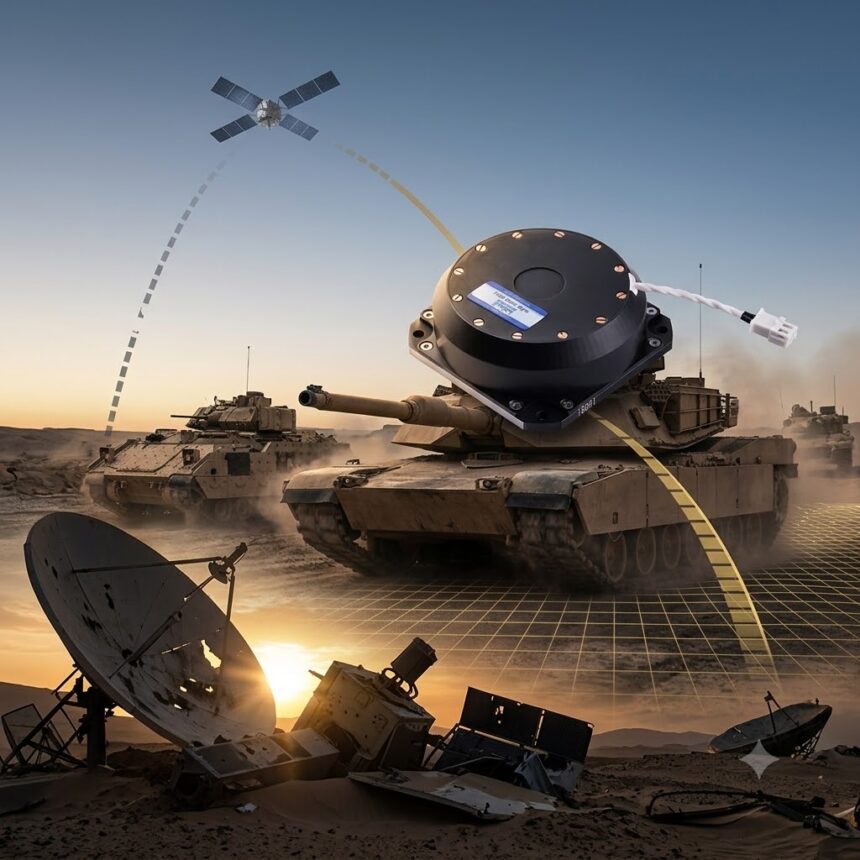
The erosion of GPS reliability through ubiquitous jamming, spoofing, and counterspace threats has rendered infrastructure-independent navigation a strategic imperative for modern land warfare, with Fiber Optic Gyroscope (FOG) technology emerging as the critical enabler for maintaining combat effectiveness in contested environments.
The GNSS Paradox and the Vulnerability of Space-Based Positioning
Global Navigation Satellite Systems (GNSS) have transformed from a decisive advantage into a critical vulnerability. Jamming and spoofing capabilities, once the domain of major powers, are now routine tactical tools across lower-intensity conflicts and major theaters alike.
The threat extends beyond electronic warfare. Adversaries are deploying counterspace capabilities at a pace described by U.S. Space Operations Chief General B. Chance Saltzman as “mind-boggling,” putting the satellite architecture itself at risk. While hardening GPS through M-Code and next-generation receivers improves resilience, these solutions remain tethered to a physical satellite infrastructure that can be targeted or degraded.
A unit that cannot determine its orientation cannot maneuver, synchronize effects, or deliver precision fires. In practical terms, it becomes combat ineffective.
FOG Technology: Restoring Autonomous Orientation and Navigation
High-performance inertial navigation systems (INS) provide the only fully passive solution, emitting no signals and receiving none. They function as a platform’s internal “source of truth,” relying on constants like gravity and Earth’s rotation to ensure continuity when external signals fail.
Among inertial technologies, the Fiber Optic Gyroscope (FOG) stands out for high-intensity conflict. Its superior long-term bias stability enables extended dead-reckoning with minimal cumulative error, effectively bridging GNSS-denied operations. FOGs also provide instantaneous north-seeking capability, allowing platforms to determine True North autonomously—whether stationary or maneuvering on rugged terrain—without external movement or signal reference.
Unlike legacy mechanical gyros, FOGs have no moving parts, delivering exceptional robustness against combat shock and vibration with near-zero maintenance requirements. This represents the optimal intersection of high-performance capability and cost-effective lifecycle management.
The Strategic Imperative for Independent Navigation
Prioritizing FOG-based inertial navigation is no longer a niche technical choice but a strategic requirement. By leveraging advances in photonics and inertial sensing, these systems enable assured navigation, resilient maneuver, and precision engagement independent of external infrastructure.
The adoption of advanced physics to ensure reliable navigation delivers more than high-end hardware; it provides operational resilience regardless of the state of the skies. In the warfare of tomorrow, signals may fail, but physics never lies.
— Originally reported by Breaking Def.. Adapted and republished with editorial context for SpaceSecurityNews.