

Space Security News
  • Home
  • News

    Vast recruits Slingshot co-founder to lead defense satellite push

    July 27, 2026

    Commerce department launches voluntary certification for novel space missions

    July 27, 2026
    Sentinel satellite overlooking the Strait of Hormuz shipping lanes

    EU halts Copernicus imagery release near Iran war zone

    July 27, 2026
    Military GPS satellite with encrypted signal beams in orbit

    Air Force seizes control of troubled jam-proof GPS receiver project

    July 27, 2026
  • Features

    Classified Chinese satellite sweeps the geostationary belt for threats

    July 24, 2026

    Japan’s JAXA tests reusable rocket RV-X in milestone for space infrastructure

    July 24, 2026

    Software-defined radios open new attack surface for satellite networks

    July 22, 2026

    GPS jamming wave pushes UK toward self-reliant satellite security

    July 21, 2026
  • Spotlight
  • Events
  • About Us
    • Mission
    • Services
    • Contact Us
Reading: OPSWAT Sends Device Toward Space to Demonstrate Prevention-First Cybersecurity for Extreme Environments
Share
Search
  • Trending:
  • Alliances
  • Cislunar
  • Commercial
  • Communications
  • Cyber
  • Debris
  • Defense
  • Deterrence
  • Intelligence
  • Launch
  • Strategy
  • Surveillance
  • Missile
  • Navigation
  • War
Font ResizerAa
Space Security NewsSpace Security News
  • Home
  • News
  • Features
  • Spotlight
  • Events
  • About Us
Search
  • Home
  • News
  • Features
  • Spotlight
  • Events
  • About Us
    • Mission
    • Services
    • Contact Us
Follow US
© 2026 Space Security News. All Rights Reserved.
Emerging Threats & Tech

OPSWAT Sends Device Toward Space to Demonstrate Prevention-First Cybersecurity for Extreme Environments

By
SSN Staff
Last updated: June 30, 2026
3 Min Read
Share

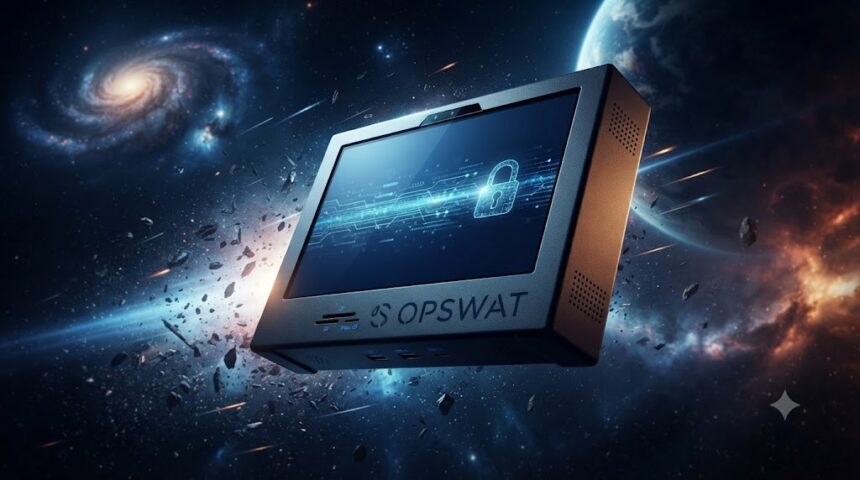
OPSWAT has successfully demonstrated its MetaDefender Kiosk Mini operating in near-space conditions, processing thousands of malware samples from removable media at altitudes exceeding 100,000 feet without cloud connectivity or human intervention.

Contents
  • Mission Validates Offline Cybersecurity for Extreme Environments
  • Deep CDR and Ruggedized Design Enable Autonomous Operation
  • Implications for a Growing Threat Landscape

Mission Validates Offline Cybersecurity for Extreme Environments

Attached to a weather balloon, the device reached 104,883 feet, enduring temperatures of -45.6°F, near-vacuum pressures of 9.5 hPa, and high radiation levels. After nearly 230 minutes of ascent, the balloon burst, and the kiosk continued sanitizing data during freefall before landing in a river.

The mission was not a publicity stunt but a targeted stress test. Satellites, defense systems, remote energy facilities, and industrial sites often lack reliable internet access or immediate human support. In these settings, conventional endpoint security models fail, requiring cybersecurity that is local, deterministic, and prevention-first.

Deep CDR and Ruggedized Design Enable Autonomous Operation

Operating without cloud connectivity, the MetaDefender Kiosk Mini relied on OPSWAT’s Deep CDR Technology, which assumes every file may be malicious, removes risky active content, and regenerates a clean version. The device’s rugged design, certified Class 1, Division 2 by UL, qualifies it for use in hazardous environments such as oil and gas, chemical, and mining operations.

“Space systems should be treated as critical infrastructure, and the cyber infrastructure that supports them should be treated as mission-critical infrastructure,” said Benny Czarny, Founder and CEO of OPSWAT. “Cybersecurity in space cannot be built around the idea that someone on Earth will always be available to fix the problem.”

Implications for a Growing Threat Landscape

The World Economic Forum’s Global Cybersecurity Outlook 2026 found that 15% of organizations now consider space-based assets in their cyber risk mitigation strategies. As access to orbit becomes cheaper, the line between terrestrial cyber risk and space-enabled operations is blurring. Future threats could include electronic warfare, spoofing, jamming, interception, and spacecraft positioned to support attacks against ground targets.

The mission underscores a fundamental shift: cybersecurity must function in environments where humans cannot easily reach, repair, or reset. In space, there is no simple onsite support or second chance. Systems must have full trust before they leave the ground, making prevention-first, autonomous security not just an advantage but a requirement.

– Originally reported by BusinessWire / OPSWAT. Adapted and republished with editorial context for SpaceSecurityNews.


Sign Up For Daily Newsletter

Be keep up! Get the latest breaking news delivered straight to your inbox.
By signing up, you agree to our Terms of Use and acknowledge the data practices in our Privacy Policy. You may unsubscribe at any time.
Share This Article
Facebook Email Copy Link Print

LATEST NEWS

Vast recruits Slingshot co-founder to lead defense satellite push

News
July 27, 2026

Commerce department launches voluntary certification for novel space missions

The Office of Space Commerce rolls out a voluntary certification system for novel space activities…

July 27, 2026
Sentinel satellite overlooking the Strait of Hormuz shipping lanes

EU halts Copernicus imagery release near Iran war zone

The EU imposed a 24-hour restriction on Sentinel satellite imagery of the Gulf of Oman…

July 27, 2026
Military GPS satellite with encrypted signal beams in orbit

Air Force seizes control of troubled jam-proof GPS receiver project

The Air Force absorbed the Pentagon's M-code GPS receiver program from the Space Force after…

July 27, 2026

YOU MAY ALSO LIKE

NSA reveals details of new LEO security report

The US National Security Agency just dropped a new playbook for securing the internet's fastest-growing frontier: low Earth orbit satellites.

Emerging Threats & TechFeatures
May 13, 2026

FBI and partners warn space companies of foreign intelligence cyberattacks

US intelligence agencies issued a joint advisory warning that foreign state actors are increasingly targeting the commercial space industry through…

Emerging Threats & Tech
July 18, 2026

Pulse Space wins $40 million Space Force contract for laser power tech

The Space Force awards $40 million to Pulse Space for laser-based power and data transmission between satellites.

Emerging Threats & Tech
July 13, 2026

Russian satellites move within striking distance of ICEYE radar satellite supplying intelligence to Ukraine

Russian military satellites have sidled up to a commercial radar spy satellite that feeds intelligence to Ukraine, and the orbital…

Emerging Threats & TechSatellite SecuritySpotlight
May 25, 2026

Breaking developments in space and cybersecurity, decoded for the modern defense and technology landscape.

Follow us: 

  • News
  • Features
  • Spotlight
  • Events
  • About Us
  • Mission
  • Services
  • Contact Us
Copyright © 2026 Space Security News. All Rights Reserved.
Privacy Policy | Legal
Welcome Back!

Sign in to your account

Username or Email Address
Password

Lost your password?