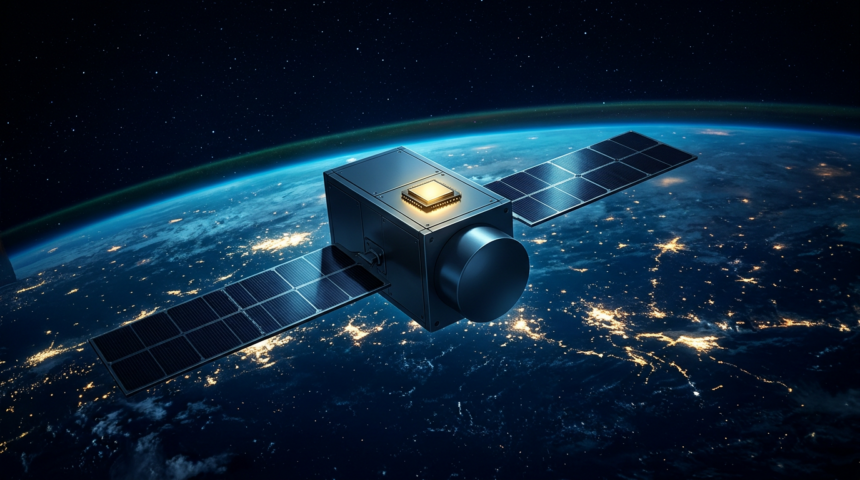
WISeSat.Space put a new secure-hardware testbed into orbit this week, and the payload matters more than the launch. FOSSASAT-2E27, a 6U spacecraft built by Spain’s FOSSA Systems, rode a SpaceX Falcon 9 rideshare to orbit and now carries secure elements from SEALSQ, the semiconductor arm of the same corporate family.
The silicon on board is VaultIC-class hardware, a tamper-resistant secure element already proven in terrestrial payment and identity systems. WISeSat and FOSSA have agreed to stretch that testing across up to six missions, with six-month monitoring windows per experiment, before qualifying SEALSQ’s next-generation QS7001 post-quantum chip for flight.
Why a chip test counts as security news
Satellite operators have spent a decade hardening ground networks while leaving the spacecraft bus dependent on commercial components with no flight heritage in cryptography. A secure element that holds keys in tamper-resistant silicon changes the threat model for command authentication, the weakest link in most smallsat architectures.
The timing is regulatory as much as technical. U.S. Executive Order 14412, signed in June, sets an accelerated federal migration to post-quantum cryptography with requirements phasing in from 2030. WISeSat is betting that demonstrated in-orbit performance, not laboratory certification, becomes the purchasing test for governments facing that deadline.
The spacecraft also carries software-defined radio, onboard AI processing and an electric propulsion demonstrator, making it a test article as much as a satellite. WISeSat’s roadmap points toward a planned Quantum Spatial Orbital Cloud for secure communications.
For buyers, the takeaway is narrow but useful. Post-quantum claims in space are moving from white papers to flight logs. What FOSSASAT-2E27 will not answer is how anyone audits those logs independently.