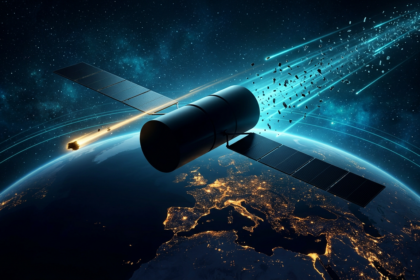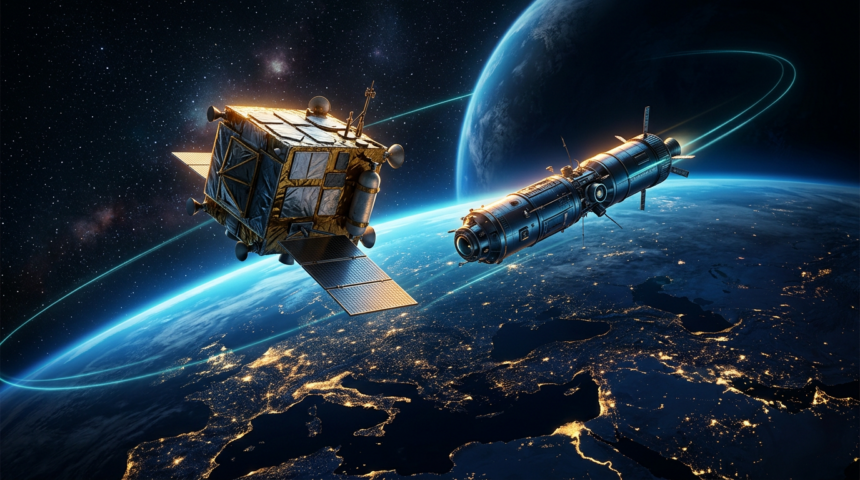
Analysts see the signature of a test rather than an accident in the slow approach of a Russian military satellite toward a commercial radar spacecraft that supplies imagery to Ukraine.
On October 15 the warning was published by CSIS, whose Aerospace Security Project tracked Cosmos 2612 onto a trajectory that brings it into very close proximity with an ICEYE synthetic aperture radar satellite registered in the United States. Founded in Finland, ICEYE operates a fleet that has become one of Kyiv’s more resilient eyes on the battlefield.
The plane change that started it
April is when the setup began, with the launch of Cosmos 2609 through Cosmos 2614. Inclinations were raised a month later by five of those six spacecraft, dropping them into the same orbital plane as the ICEYE craft. A plane change consumes far more propellant than an altitude boost, and few commercial missions budget for it.
Once coplanar, the trailing spacecraft closes the distance cheaply.
Object release rehearsed before
Years of object-release rehearsal precede this. A nesting doll is how a senior US official described a 2017 release, adding that the hardware exhibited characteristics of a weapon system. An object released by Cosmos 2543 in July 2020 traveled at up to 186 meters per second relative to its host.
A key distinction is drawn by the CSIS authors, Clayton Swope and Chantal Li: Russian satellites have come close to other Russian satellites, but no public information shows them doing so near a foreign spacecraft.
Inside a broader hybrid campaign the approach sits, they argue, citing cyberattacks, navigation jamming and planned sabotage of undersea cables and ground space infrastructure.
Deterrence is the open question. A strike on a Western satellite may look wildly escalatory to Western capitals, yet Moscow may see a muted response as likelier.