

Space Security News
  • Home
  • News

    Vast recruits Slingshot co-founder to lead defense satellite push

    July 27, 2026

    Commerce department launches voluntary certification for novel space missions

    July 27, 2026
    Sentinel satellite overlooking the Strait of Hormuz shipping lanes

    EU halts Copernicus imagery release near Iran war zone

    July 27, 2026
    Military GPS satellite with encrypted signal beams in orbit

    Air Force seizes control of troubled jam-proof GPS receiver project

    July 27, 2026
  • Features

    Classified Chinese satellite sweeps the geostationary belt for threats

    July 24, 2026

    Japan’s JAXA tests reusable rocket RV-X in milestone for space infrastructure

    July 24, 2026

    Software-defined radios open new attack surface for satellite networks

    July 22, 2026

    GPS jamming wave pushes UK toward self-reliant satellite security

    July 21, 2026
  • Spotlight
  • Events
  • About Us
    • Mission
    • Services
    • Contact Us
Reading: Unseen Threats Overhead: Drones Endanger U.S. Rocket Launch Sites
Share
Search
  • Trending:
  • Alliances
  • Cislunar
  • Commercial
  • Communications
  • Cyber
  • Debris
  • Defense
  • Deterrence
  • Intelligence
  • Launch
  • Strategy
  • Surveillance
  • Missile
  • Navigation
  • War
Font ResizerAa
Space Security NewsSpace Security News
  • Home
  • News
  • Features
  • Spotlight
  • Events
  • About Us
Search
  • Home
  • News
  • Features
  • Spotlight
  • Events
  • About Us
    • Mission
    • Services
    • Contact Us
Follow US
© 2026 Space Security News. All Rights Reserved.
Emerging Threats & Tech

Unseen Threats Overhead: Drones Endanger U.S. Rocket Launch Sites

By
SSN Staff
Last updated: July 1, 2026
5 Min Read
Share

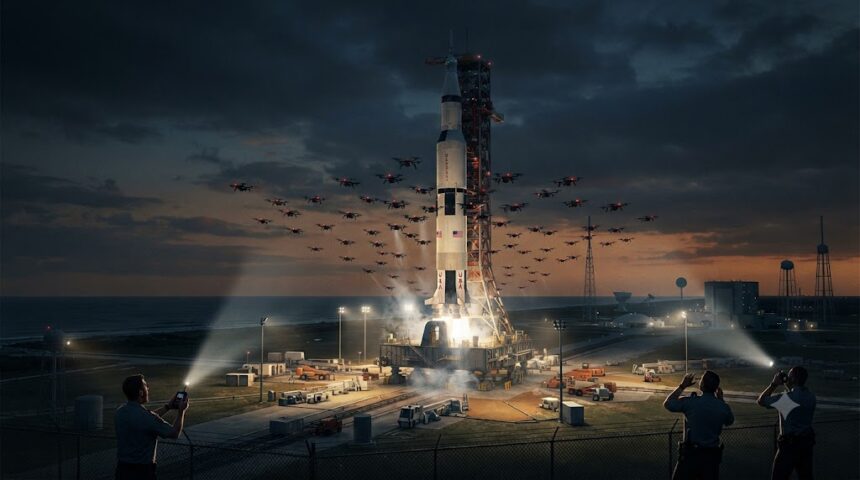
The rising prevalence of drone incursions over U.S. military launch ranges poses a direct and escalating threat to national security, with a single errant or hostile unmanned aircraft capable of triggering multi-million-dollar launch scrubs and cascading delays across the entire space enterprise. In November 2024, a Chinese national flew a drone over Vandenberg Space Force Base for nearly an hour, photographing the installation after researching ways to bypass altitude limits. Two months later, a Chinese-born Canadian citizen made multiple drone flights over Cape Canaveral, capturing images of launch complexes and munitions bunkers. These rare prosecutions underscore a stark reality: most drone operators who violate restricted airspace are never caught.

Contents
  • The Expanding Threat Landscape
  • Operational and Economic Consequences
  • A Path Forward: Layered Defense and Shared Awareness
  • What This Means

The Expanding Threat Landscape

The commander of NORAD and U.S. Northern Command reported to Congress in February 2025 that 350 drone detections occurred over roughly 100 military installations in a single year. More recently, Barksdale Air Force Base, home to the nation’s B-52 bomber fleet, detected multiple unauthorized drone incursions prompting a shelter-in-place order. These incidents mirror the vulnerability of space launch ranges, where strategic assets are exposed to both careless operators and deliberate adversaries. The Eastern and Western Ranges supported 186 launches in 2025, with the Space Force projecting nearly 300 launches annually at the Eastern Range alone by 2030. More launches mean more exposure, creating expanded opportunities for disruption.

Operational and Economic Consequences

A scrubbed launch carries far more than schedule disruption. SpaceX has argued in litigation that a single scrub can cost approximately $4 million per day, while NASA’s Space Shuttle program previously estimated direct costs at $1.2 million per incident. Beyond financial impact, a drone collision during fueling or liftoff could cause catastrophic damage to infrastructure requiring years and millions of dollars to repair. Weaponized drones, as demonstrated in Ukraine and the Middle East, could carry explosives into fueled rockets or fuel storage, or be equipped for signals intelligence collection and cyber intrusion against range networks. No such attack has occurred on U.S. ranges, but current detection, tracking, and identification technology remains inadequate for the threat.

A Path Forward: Layered Defense and Shared Awareness

The U.S. launch enterprise must act on three simultaneous fronts. First, build shared situational awareness through a Common Operating Picture (COP) that fuses radar, RF detection, acoustic sensors, and other technologies into a single interface. No single sensor can catch every drone; radar misses small, low-flying targets, and RF detection fails against preprogrammed GPS routes. A layered defense merged into a COP allows range safety, security forces, FAA controllers, and law enforcement to act from a unified decision-support tool. Second, deploy properly funded counter-drone systems calibrated to the operating environment, avoiding proprietary displays that force defenders to reconcile conflicting data under time-critical conditions. Third, update the legal framework to enable rapid, lawful responses to drone interference with space launch operations.

What This Means

The damage from even a single drone-induced delay extends far beyond the rocket on the pad. Every satellite, crewed mission, and scientific payload has strategic relevance, and an adversary need not destroy a launch vehicle—merely delay it long enough to cascade schedule disruptions across the manifest. As drone costs decline and ease of use increases, the threat will only intensify. The difference between a careless operator and a hostile actor matters less than the outcome: a drone near a launch pad during countdown demands the same response—hold, scrub, or abort. The U.S. launch enterprise cannot afford to treat these incursions as nuisances. They are mission denial events that erode confidence in American launch range reliability at a time when global competition is accelerating.

— Originally reported by SpaceNews. Adapted and republished with editorial context for SpaceSecurityNews.


Sign Up For Daily Newsletter

Be keep up! Get the latest breaking news delivered straight to your inbox.
By signing up, you agree to our Terms of Use and acknowledge the data practices in our Privacy Policy. You may unsubscribe at any time.
Share This Article
Facebook Email Copy Link Print

LATEST NEWS

Vast recruits Slingshot co-founder to lead defense satellite push

News
July 27, 2026

Commerce department launches voluntary certification for novel space missions

The Office of Space Commerce rolls out a voluntary certification system for novel space activities…

July 27, 2026
Sentinel satellite overlooking the Strait of Hormuz shipping lanes

EU halts Copernicus imagery release near Iran war zone

The EU imposed a 24-hour restriction on Sentinel satellite imagery of the Gulf of Oman…

July 27, 2026
Military GPS satellite with encrypted signal beams in orbit

Air Force seizes control of troubled jam-proof GPS receiver project

The Air Force absorbed the Pentagon's M-code GPS receiver program from the Space Force after…

July 27, 2026

YOU MAY ALSO LIKE

NRL awards Parsons $245 million satellite ground systems contract

Naval Research Laboratory selects Parsons to develop next-generation satellite ground systems under a $245 million contract for space defense infrastructure.

Emerging Threats & TechNewsSatellite Security
July 18, 2026

Russian satellites move within striking distance of ICEYE radar satellite supplying intelligence to Ukraine

Russian military satellites have sidled up to a commercial radar spy satellite that feeds intelligence to Ukraine, and the orbital…

Emerging Threats & TechSatellite SecuritySpotlight
May 25, 2026

Latest White House cybersecurity strategy talks crypto, AI, quantum

The White House’s latest cyber strategy name-drops quantum, AI, and even crypto—but space, the domain where the US military is…

Emerging Threats & TechFeatures
May 12, 2026

Indian Space-Tech Startup QOSMIC Raises $3.3M for Optical Communication Infrastructure

QOSMIC, an Indian space-tech startup building optical communication infrastructure for space, has secured $3.3 million in seed funding to accelerate…

Emerging Threats & Tech
July 2, 2026

Breaking developments in space and cybersecurity, decoded for the modern defense and technology landscape.

Follow us: 

  • News
  • Features
  • Spotlight
  • Events
  • About Us
  • Mission
  • Services
  • Contact Us
Copyright © 2026 Space Security News. All Rights Reserved.
Privacy Policy | Legal
Welcome Back!

Sign in to your account

Username or Email Address
Password

Lost your password?