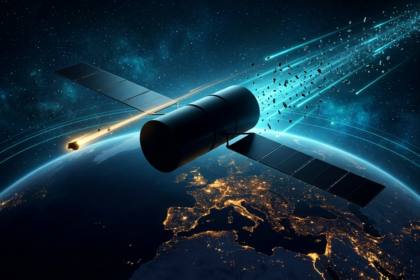


A Chinese satellite that flies a rare retrograde orbit has apparently broken up, leaving a field of debris that US trackers say could linger for decades.
The US Space Force’s 18th Space Defense Squadron has cataloged 43 fragments from the breakup of Yaogan-50 (02), according to Jonathan McDowell, a Harvard-Smithsonian astronomer who monitors space activity. The pieces sit roughly 600 to 1,100 kilometers up, sharing the spacecraft’s retrograde path, which tilts about 142 degrees and runs counter to Earth’s rotation. Objects meeting head-on in opposite directions collide at extreme speeds, so the cloud adds fresh collision risk for other satellites.
Yaogan-50 (02) lifted off March 15 on a Long March 6A rocket from Taiyuan, joining a sister spacecraft launched in January. Retrograde orbits are unusual because they cost payload mass, but they allow frequent passes over mid-latitude regions including China. The satellite was built by the China Academy of Space Technology, a CASC arm that describes the series as civilian remote sensing. Outside analysts judge Yaogan spacecraft to carry intelligence, surveillance and reconnaissance payloads, including radar, optical and signals sensors.
The cause of the breakup is unclear, with experts pointing to a propulsion or battery failure or a collision with space junk. Beijing’s own tracking service, Spacemapper, lists only four pieces so far, and CASC has not commented. At that altitude, atmospheric drag is negligible, meaning the fragments will probably stay in orbit for decades.