

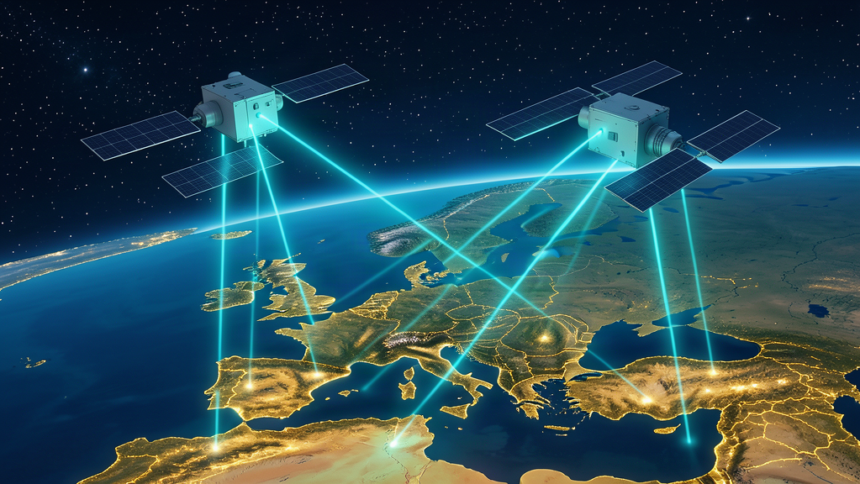
Europe’s answer to sovereign secure connectivity has entered a design phase, with the European Space Agency signing 18 study contracts worth €20M to examine how its IRIS2 constellation could grow downward into lower orbits.
ESA signed them at its European Space Astronomy Centre outside Madrid on 17 September. The work pulls in nearly 80 companies, research institutes and technology firms. Laurent Jaffart, who leads ESA’s resilience, navigation and connectivity directorate, signed on the agency’s behalf.
Smaller orbits, harder cryptography
ESA groups the contracts under its Low-LEO programme. The point is to work out what IRIS2 should look like as government users ask for more, and different, services. Concepts under study span secure government broadband, aviation and maritime links, plus data relay and satellite tasking.
Engineering strands cover the problems that come with flying lower, among them atmospheric drag, propulsion efficiency, optical inter-satellite links and tighter frequency reuse. Two contract lines target quantum-resistant payloads, including quantum key distribution and post-quantum cryptography for government traffic.
IRIS2 is the EU’s multi-orbit sovereign network, meant to sit alongside Galileo for navigation and Copernicus for Earth observation while cutting reliance on non-European operators. Industrial names attached to the low-orbit studies so far include Sateliot and Indra Space.
The contracts are concept work rather than hardware orders. They still signal where Brussels expects pressure to build: lower, cheaper orbits where latency falls and a jammed or spoofed link leaves less margin for error.



