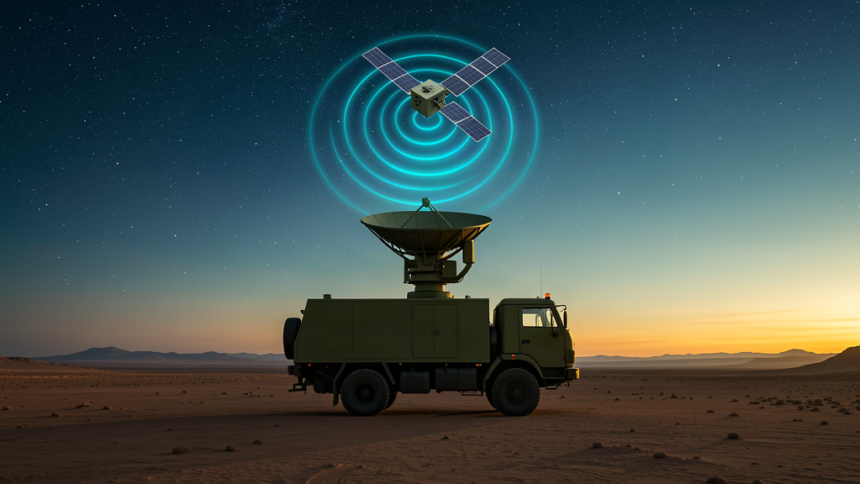
The Army is spreading nearly $67 million across five companies to build prototype electromagnetic warfare systems meant to keep enemy satellites from finding US ground forces.
The awards, announced September 30 from Redstone Arsenal, are standalone Other Transaction Authority agreements with an 18 to 20 month window. KBR-Kord leads at $22.4M, followed by Ideas, Commitment, Results at $18.8M and Systems and Technology Research at $10.9M. Raytheon holds $7.6M and Northrop Grumman-Xetron $6.9M.
What the prototypes must do
The work feeds the Army’s counter surveillance and reconnaissance initiative, which exists because overhead sensing has made it harder to hide a brigade. It sits under Product Manager Tactical Space Superiority, part of the service’s Intelligence and Spectrum Warfare portfolio.
Kent Shea, who runs that office, said non-kinetic effects will help the Army hold freedom of maneuver and preserve combat power as activity in orbit keeps expanding.
Jamming without littering orbit
The Army has spent two years arguing that counterspace belongs to the land force. Its Transformation Integration Directorate for Space Superiority wants tools that can disrupt adversary sensing satellites while respecting national policy that rules out destructive anti-satellite tests and the debris they leave behind.
Each team now has to reach field experimentation and exercises. Evaluators there will judge effectiveness, survivability and whether the designs can scale into production.