

Space Security News
  • Home
  • News

    Vast recruits Slingshot co-founder to lead defense satellite push

    July 27, 2026

    Commerce department launches voluntary certification for novel space missions

    July 27, 2026
    Sentinel satellite overlooking the Strait of Hormuz shipping lanes

    EU halts Copernicus imagery release near Iran war zone

    July 27, 2026
    Military GPS satellite with encrypted signal beams in orbit

    Air Force seizes control of troubled jam-proof GPS receiver project

    July 27, 2026
  • Features

    Classified Chinese satellite sweeps the geostationary belt for threats

    July 24, 2026

    Japan’s JAXA tests reusable rocket RV-X in milestone for space infrastructure

    July 24, 2026

    Software-defined radios open new attack surface for satellite networks

    July 22, 2026

    GPS jamming wave pushes UK toward self-reliant satellite security

    July 21, 2026
  • Spotlight
  • Events
  • About Us
    • Mission
    • Services
    • Contact Us
Reading: Army Air Assault Brigade Found AI Tools Ill-Suited to Tactical Planning
Share
Search
  • Trending:
  • Alliances
  • Cislunar
  • Commercial
  • Communications
  • Cyber
  • Debris
  • Defense
  • Deterrence
  • Intelligence
  • Launch
  • Strategy
  • Surveillance
  • Missile
  • Navigation
  • War
Font ResizerAa
Space Security NewsSpace Security News
  • Home
  • News
  • Features
  • Spotlight
  • Events
  • About Us
Search
  • Home
  • News
  • Features
  • Spotlight
  • Events
  • About Us
    • Mission
    • Services
    • Contact Us
Follow US
© 2026 Space Security News. All Rights Reserved.
Threat Actors & Incidents

Army Air Assault Brigade Found AI Tools Ill-Suited to Tactical Planning

By
SSN Staff
Last updated: June 25, 2026
3 Min Read
Share

The 101st Airborne Division’s 3rd Mobile Brigade Combat Team has concluded that large language models (LLMs) are ill-suited for tactical course-of-action development after a year-long integration of artificial intelligence into its planning processes, according to its commander, Col. Ryan Bell.

Contents
  • AI Proves Ineffective for Tactical Maneuver Planning
  • Operational Gains in Tempo and Orders Processing
  • Data Processing at Scale

Speaking to reporters following an April rotation at the Joint Readiness Training Center at Fort Polk, La., Bell detailed the brigade’s pragmatic assessment of AI’s capabilities and limitations. The unit trained LLMs on joint, Army, and division doctrine, creating specialized bots for each staff section to accelerate understanding of the operating environment.

AI Proves Ineffective for Tactical Maneuver Planning

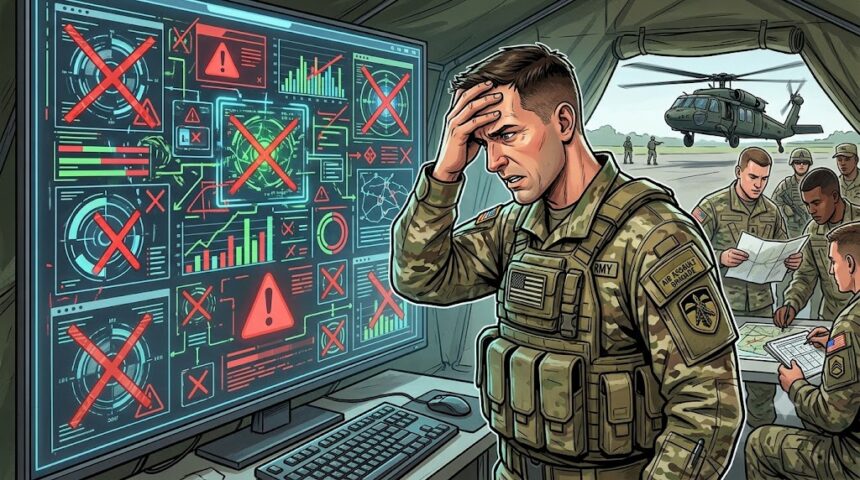
Despite industry hype positioning AI as a key tool for battlefield scenario generation, Bell explicitly ruled out using the technology for course-of-action development. “Large language models don’t really understand three-dimensional space,” he said. “That’s where you need the expertise of a skilled staff to understand the art of war fighting.”

The brigade found that while AI could simulate and test potential courses of action ahead of enemy contact, it could not replace human judgment in crafting maneuver plans. The technology’s inability to grasp spatial relationships in a contested environment remains a fundamental constraint.

Operational Gains in Tempo and Orders Processing

Where AI delivered measurable value was in accelerating the orders process and enabling deeper wargaming. Bell reported that using AI tools, the brigade could push a warning order to subordinate units in under 30 minutes—a process that previously required hours.

In a defensive scenario, battalions received their orders 72 hours ahead of the opposing force’s reconnaissance push. “It enabled the battalions to fully work through their planning cycle… put in 100 percent of the plan obstacles, refine, rehearse,” Bell said. This time advantage allowed units to build defenses that withstood multiple chemical attacks and robotic breach attempts.

Data Processing at Scale

Over ten days of operations, the brigade’s intelligence section processed more than 25,000 spot reports from drone sensors using AI. “It helped us make sense of the battlefield and respond faster than Geronimo,” Bell noted, referring to the opposing force.

The commander emphasized that tempo will be a decisive characteristic in future operating environments. While drones accelerate sensing and striking, AI proved its worth at the staff level by compressing planning cycles and sustaining operational momentum.

The 101st’s experience offers a clear signal for defense procurement: AI excels at accelerating administrative and analytical workflows but cannot substitute for human expertise in the art of war. As the Army pushes toward broader AI adoption, the distinction between tactical decision-making and operational support will define where the technology delivers—and where it falls short.

— Originally reported by Breaking Def.. Adapted and republished with editorial context for SpaceSecurityNews.


Sign Up For Daily Newsletter

Be keep up! Get the latest breaking news delivered straight to your inbox.
By signing up, you agree to our Terms of Use and acknowledge the data practices in our Privacy Policy. You may unsubscribe at any time.
Share This Article
Facebook Email Copy Link Print

LATEST NEWS

Vast recruits Slingshot co-founder to lead defense satellite push

News
July 27, 2026

Commerce department launches voluntary certification for novel space missions

The Office of Space Commerce rolls out a voluntary certification system for novel space activities…

July 27, 2026
Sentinel satellite overlooking the Strait of Hormuz shipping lanes

EU halts Copernicus imagery release near Iran war zone

The EU imposed a 24-hour restriction on Sentinel satellite imagery of the Gulf of Oman…

July 27, 2026
Military GPS satellite with encrypted signal beams in orbit

Air Force seizes control of troubled jam-proof GPS receiver project

The Air Force absorbed the Pentagon's M-code GPS receiver program from the Space Force after…

July 27, 2026

YOU MAY ALSO LIKE

In Defence Investment Plan Preview, Britain Bets Big on Drones, ‘Hybrid’ Navy

The United Kingdom is pivoting its defense strategy toward a hybrid, unmanned-centric force structure, announcing a £5 billion ($6.6 billion)…

Threat Actors & Incidents
June 30, 2026

The role of integrated simulation in Europe’s defense modernization

Lockheed Martin's Advanced Center for Experimentation and Simulation (ACES) delivers a unified modeling and simulation platform designed to close critical…

FeaturesThreat Actors & Incidents
June 2, 2026

Space Force designates third PAE tranche for electromagnetic warfare and cyber

The third tranche of Portfolio Alignment Effort designates electromagnetic warfare and cybersecurity as dedicated mission areas within the Space Force…

NewsSatellite SecurityThreat Actors & Incidents
July 18, 2026

Belgium Drops Three and a Half Billion to Build a Shared Air Defense Arsenal

Belgium has committed €3.1 billion ($3.5 billion) to a joint air defense procurement with the Netherlands, marking a major step…

Threat Actors & Incidents
July 8, 2026

Breaking developments in space and cybersecurity, decoded for the modern defense and technology landscape.

Follow us: 

  • News
  • Features
  • Spotlight
  • Events
  • About Us
  • Mission
  • Services
  • Contact Us
Copyright © 2026 Space Security News. All Rights Reserved.
Privacy Policy | Legal
Welcome Back!

Sign in to your account

Username or Email Address
Password

Lost your password?