

Space Security News
  • Home
  • News

    Ukrainian cyber operation exposes Russia’s missile and space design institute

    September 10, 2026

    TrustPoint books 40 spacecraft to scale its GPS-free navigation net

    September 10, 2026

    Simulators let guardians rehearse satellite combat without risking the fleet

    September 10, 2026

    Pentagon nearly doubles national security launch buys as bill hits $76B

    September 9, 2026
  • Features

    First live-fly space exercise puts real satellites through orbital agility drills

    September 9, 2026

    US war game ends with two rival missile shields and no deal

    September 9, 2026

    Britain folds space defense and civil work into one £7.8B plan

    September 9, 2026

    Bundeswehr scouts jammers and spoofers to counter Russian satellites

    September 7, 2026
  • Spotlight
  • Events
  • About Us
    • Mission
    • Services
    • Contact Us
Reading: Beyond satellites: why FOG inertial navigation is the new imperative for land warfare
Share
Search
  • Trending:
  • Alliances
  • Cislunar
  • Commercial
  • Communications
  • Cyber
  • Debris
  • Defense
  • Deterrence
  • Intelligence
  • Launch
  • Strategy
  • Surveillance
  • Missile
  • Navigation
  • War
Font ResizerAa
Space Security NewsSpace Security News
  • Home
  • News
  • Features
  • Spotlight
  • Events
  • About Us
Search
  • Home
  • News
  • Features
  • Spotlight
  • Events
  • About Us
    • Mission
    • Services
    • Contact Us
Follow US
© 2026 Space Security News. All Rights Reserved.
FeaturesSatellite Security

Beyond satellites: why FOG inertial navigation is the new imperative for land warfare

By
SSN Staff
Last updated: May 26, 2026
3 Min Read
Share

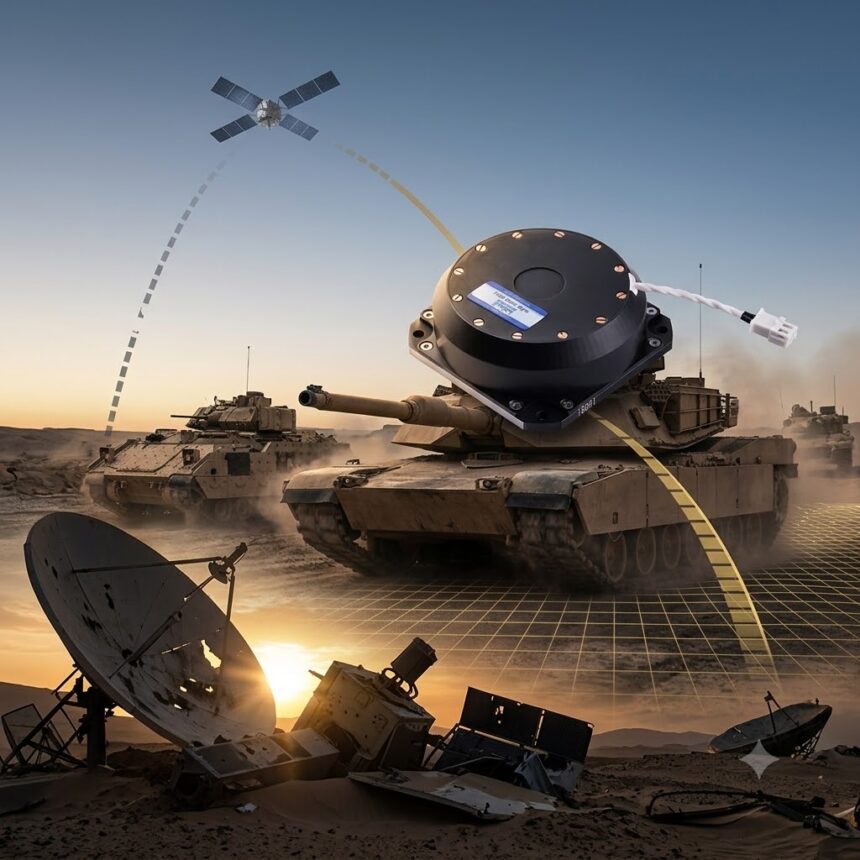
The erosion of GPS reliability through ubiquitous jamming, spoofing, and counterspace threats has rendered infrastructure-independent navigation a strategic imperative for modern land warfare, with Fiber Optic Gyroscope (FOG) technology emerging as the critical enabler for maintaining combat effectiveness in contested environments.

Contents
  • The GNSS Paradox and the Vulnerability of Space-Based Positioning
  • FOG Technology: Restoring Autonomous Orientation and Navigation
  • The Strategic Imperative for Independent Navigation

The GNSS Paradox and the Vulnerability of Space-Based Positioning

Global Navigation Satellite Systems (GNSS) have transformed from a decisive advantage into a critical vulnerability. Jamming and spoofing capabilities, once the domain of major powers, are now routine tactical tools across lower-intensity conflicts and major theaters alike.

The threat extends beyond electronic warfare. Adversaries are deploying counterspace capabilities at a pace described by U.S. Space Operations Chief General B. Chance Saltzman as “mind-boggling,” putting the satellite architecture itself at risk. While hardening GPS through M-Code and next-generation receivers improves resilience, these solutions remain tethered to a physical satellite infrastructure that can be targeted or degraded.

A unit that cannot determine its orientation cannot maneuver, synchronize effects, or deliver precision fires. In practical terms, it becomes combat ineffective.

FOG Technology: Restoring Autonomous Orientation and Navigation

High-performance inertial navigation systems (INS) provide the only fully passive solution, emitting no signals and receiving none. They function as a platform’s internal “source of truth,” relying on constants like gravity and Earth’s rotation to ensure continuity when external signals fail.

Among inertial technologies, the Fiber Optic Gyroscope (FOG) stands out for high-intensity conflict. Its superior long-term bias stability enables extended dead-reckoning with minimal cumulative error, effectively bridging GNSS-denied operations. FOGs also provide instantaneous north-seeking capability, allowing platforms to determine True North autonomously—whether stationary or maneuvering on rugged terrain—without external movement or signal reference.

Unlike legacy mechanical gyros, FOGs have no moving parts, delivering exceptional robustness against combat shock and vibration with near-zero maintenance requirements. This represents the optimal intersection of high-performance capability and cost-effective lifecycle management.

The Strategic Imperative for Independent Navigation

Prioritizing FOG-based inertial navigation is no longer a niche technical choice but a strategic requirement. By leveraging advances in photonics and inertial sensing, these systems enable assured navigation, resilient maneuver, and precision engagement independent of external infrastructure.

The adoption of advanced physics to ensure reliable navigation delivers more than high-end hardware; it provides operational resilience regardless of the state of the skies. In the warfare of tomorrow, signals may fail, but physics never lies.

— Originally reported by Breaking Def.. Adapted and republished with editorial context for SpaceSecurityNews.


Sign Up For Daily Newsletter

Be keep up! Get the latest breaking news delivered straight to your inbox.
By signing up, you agree to our Terms of Use and acknowledge the data practices in our Privacy Policy. You may unsubscribe at any time.
Share This Article
Facebook Email Copy Link Print

LATEST NEWS

Ukrainian cyber operation exposes Russia’s missile and space design institute

Emerging Threats & Tech
September 10, 2026

TrustPoint books 40 spacecraft to scale its GPS-free navigation net

TrustPoint has ordered 40 spacecraft from EnduroSat's U.S. arm to scale up a C-band navigation…

September 10, 2026

Simulators let guardians rehearse satellite combat without risking the fleet

The Space Force is buying portable simulators so satellite crews can rehearse jamming and interference…

September 10, 2026

Pentagon nearly doubles national security launch buys as bill hits $76B

A fresh Pentagon cost report shows the US military planning 337 rocket launches versus 151…

September 9, 2026

YOU MAY ALSO LIKE

Space Force designates third PAE tranche for electromagnetic warfare and cyber

The third tranche of Portfolio Alignment Effort designates electromagnetic warfare and cybersecurity as dedicated mission areas within the Space Force…

NewsSatellite SecurityThreat Actors & Incidents
July 18, 2026

Darknavy claims full control of the newest Starlink terminals

A Singapore-Shanghai research lab says hardware attacks gave it full administrative control of the newest Starlink user terminals.

Satellite Security
September 3, 2026

DHS advances space cybersecurity research through SPARTA framework

The Department of Homeland Security releases new resources for onboard threat detection and countermeasures as part of its Aerospace SPARTA…

Satellite Security
July 21, 2026

OrbitWhisperer AI satellite cybersecurity framework presented to NATO

Embry-Riddle professor Rosa Szurgot developed the AI-driven OrbitWhisperer framework to detect and respond to cyber threats targeting satellite systems.

NewsSatellite SecurityThreat Actors & Incidents
July 17, 2026

Breaking developments in space and cybersecurity, decoded for the modern defense and technology landscape.

Follow us: 

  • News
  • Features
  • Spotlight
  • Events
  • About Us
  • Mission
  • Services
  • Contact Us
Copyright © 2026 Space Security News. All Rights Reserved.
Privacy Policy | Legal
Welcome Back!

Sign in to your account

Username or Email Address
Password

Lost your password?