

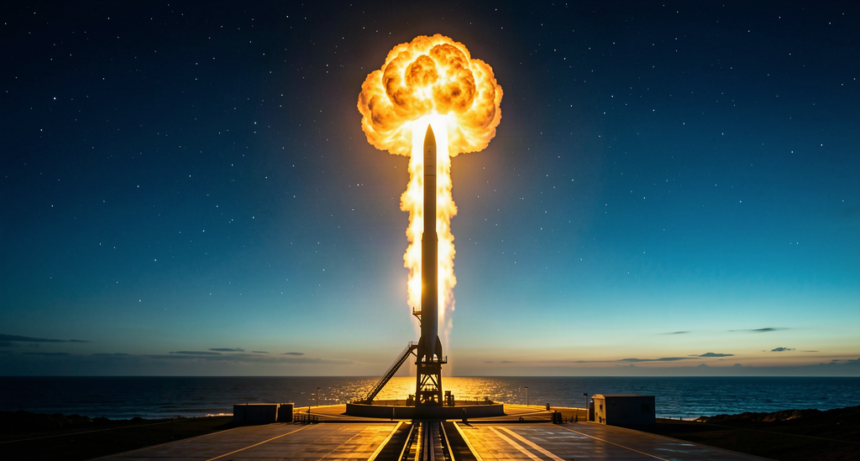
China likely lost a suspected military communications satellite on August 10 when a Long March 7A rocket exploded about 85 seconds into flight from Wenchang on Hainan island.
Amateur footage restreamed on YouTube shows the booster breaking apart shortly after the 8 a.m. Eastern liftoff. Chinese authorities had not reported the incident at press time, and it remains unclear whether the failure came from an onboard anomaly or the flight termination system.
State media identified the payload as Zhongxing-4B, part of a satellite family whose low-numbered members are widely read as military communications spacecraft. The geostationary destination matches the launcher’s usual role.
Chinese launchers have struggled in 2026. The Long March 3B and the debut Ceres-2 both failed in January, and the first Tianlong-3 was lost in early April, making the 7A the fourth failure across 56 orbital attempts so far this year.
The 7A had looked dependable since its own debut ended in an explosion in 2020, and its most recent success carried the Tianlian-3 (01) relay satellite toward geostationary orbit in late July.
The blast could unsettle unrelated programs. The first stage and boosters share YF-100 engines with the Long March 5, which is due to fly the Chang’e-7 lunar south pole mission on August 24. Beijing has offered no word on schedule changes for that flight or for military launches.