

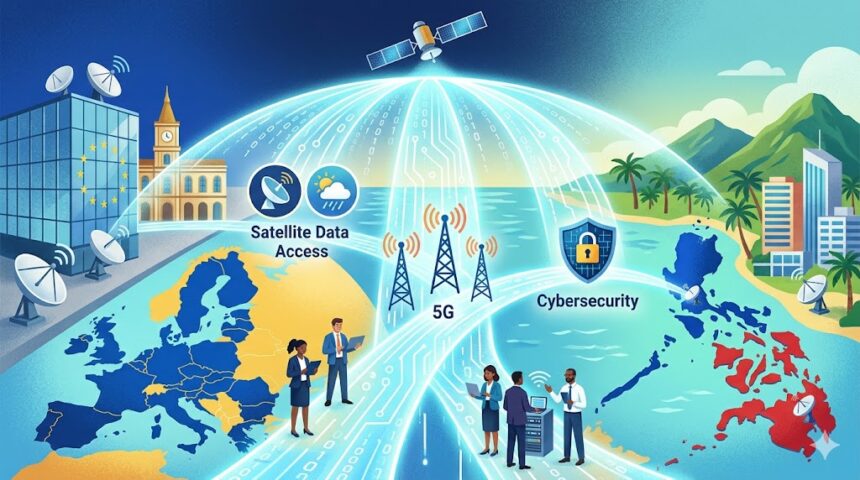
The European Union and the Philippines have formalized a strategic digital economy package that will significantly expand Manila’s access to EU satellite data, accelerate 5G infrastructure deployment, and establish a joint framework for cybersecurity resilience in space-based communications.
Satellite Data Access and Infrastructure Modernization
Under the new agreement, Philippine government agencies and research institutions will gain priority access to the EU’s Copernicus Earth observation constellation. This includes high-resolution radar and multispectral imagery critical for disaster risk reduction, maritime domain awareness, and agricultural monitoring across the archipelago.
The partnership also commits to co-investing in ground segment upgrades at Philippine receiving stations. These enhancements will reduce latency for data downlink and enable real-time processing of satellite feeds for typhoon tracking and coastal surveillance operations.
5G Integration and Space-Ground Connectivity
The digital package specifically ties 5G network expansion to satellite backhaul capabilities, targeting rural and remote islands currently lacking terrestrial fiber infrastructure. Low-Earth orbit (LEO) satellite constellations will serve as primary transport links for 5G base stations in underserved regions.
Technical working groups will align Philippine spectrum allocation policies with EU 5G standards, ensuring interoperability between satellite and terrestrial networks. This includes shared frequency bands for non-terrestrial network (NTN) services, a key enabler for direct-to-device satellite connectivity.
Cybersecurity Framework for Space Assets
A dedicated cybersecurity annex establishes joint threat intelligence sharing between the Philippine National Cybersecurity Command and the EU Agency for Cybersecurity (ENISA). The framework covers encryption standards for satellite command links, supply chain security for ground equipment, and incident response protocols for orbital assets.
Both parties will conduct biannual red-team exercises simulating attacks on satellite ground stations and 5G core networks. The agreement also mandates end-to-end encryption for all government data transmitted via EU-Philippine satellite channels, addressing vulnerabilities in legacy telemetry systems.
Strategic Implications for the Indo-Pacific
This agreement positions the Philippines as a critical node in the EU’s Indo-Pacific digital strategy, bridging European space capabilities with Southeast Asian infrastructure needs. For commercial operators, the harmonized regulatory environment reduces barriers for launching satellite services and cybersecurity products in the Philippine market.
The long-term impact will depend on implementation speed, particularly in spectrum allocation and ground station upgrades. If executed on schedule, this package could serve as a template for EU partnerships with other ASEAN states seeking to modernize space-based digital infrastructure while hardening defenses against state-sponsored cyber threats.
— Originally reported by Philippine Space Agency. Adapted and republished with editorial context for SpaceSecurityNews.