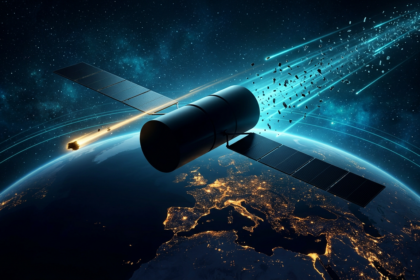
Russia’s ability to fly military satellites in coordinated maneuvers has Germany’s top space officer warning that commercial constellations could become targets, with Starlink first in line.
Major General Michael Traut, who commands the German Space Command, told Reuters that a group of Russian military satellites shadowed a Western spacecraft aiding Ukraine in May 2026. He said the display showed a capability that could be turned against commercial fleets. Traut called a direct strike on a Starlink satellite a major escalation, but said Moscow has room to operate below that line through gray-zone tactics.
He sketched one path: a Russian satellite could shift into Starlink’s orbital path and then break apart. The debris would force Starlink satellites to burn fuel dodging it, cutting their service lives without a shot being fired.
The ICEYE encounter that set the tone
US Space Force tracking found Russia moved four military satellites, Cosmos 2610 through 2613, close to a commercial radar imaging satellite run by Finland’s ICEYE, Reuters reported. ICEYE chief executive Rafal Modzewski said his company repositioned the spacecraft, and the Russian satellites maneuvered again in response. He said the episode shows close-approach flights are becoming routine, and that it sharpens the case for monitoring orbit and hardening assets.
Western officials say Russian interference with allied space systems has climbed sharply since the 2022 invasion of Ukraine, spanning ground-based jamming and in-orbit surveillance meant to probe how far the West will let it go.
Germany has moved to answer that pressure. Berlin recently won direct tasking of dedicated radar satellites and is funding jammers meant to switch off Starlink-style links from the ground. A separate US simulation modeled a Russian nuclear blast in orbit, finding the radiation belt could knock out 11,000 satellites within a week.