
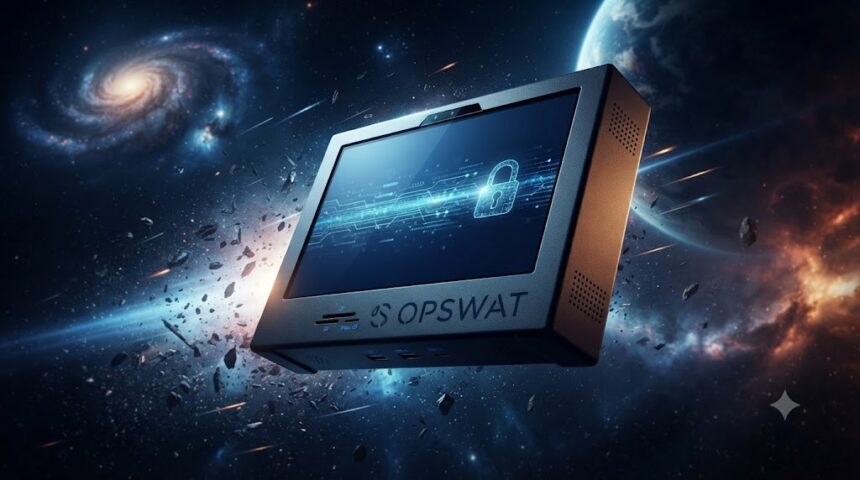
OPSWAT has successfully demonstrated its MetaDefender Kiosk Mini operating in near-space conditions, processing thousands of malware samples from removable media at altitudes exceeding 100,000 feet without cloud connectivity or human intervention.
Mission Validates Offline Cybersecurity for Extreme Environments
Attached to a weather balloon, the device reached 104,883 feet, enduring temperatures of -45.6°F, near-vacuum pressures of 9.5 hPa, and high radiation levels. After nearly 230 minutes of ascent, the balloon burst, and the kiosk continued sanitizing data during freefall before landing in a river.
The mission was not a publicity stunt but a targeted stress test. Satellites, defense systems, remote energy facilities, and industrial sites often lack reliable internet access or immediate human support. In these settings, conventional endpoint security models fail, requiring cybersecurity that is local, deterministic, and prevention-first.
Deep CDR and Ruggedized Design Enable Autonomous Operation
Operating without cloud connectivity, the MetaDefender Kiosk Mini relied on OPSWAT’s Deep CDR Technology, which assumes every file may be malicious, removes risky active content, and regenerates a clean version. The device’s rugged design, certified Class 1, Division 2 by UL, qualifies it for use in hazardous environments such as oil and gas, chemical, and mining operations.
“Space systems should be treated as critical infrastructure, and the cyber infrastructure that supports them should be treated as mission-critical infrastructure,” said Benny Czarny, Founder and CEO of OPSWAT. “Cybersecurity in space cannot be built around the idea that someone on Earth will always be available to fix the problem.”
Implications for a Growing Threat Landscape
The World Economic Forum’s Global Cybersecurity Outlook 2026 found that 15% of organizations now consider space-based assets in their cyber risk mitigation strategies. As access to orbit becomes cheaper, the line between terrestrial cyber risk and space-enabled operations is blurring. Future threats could include electronic warfare, spoofing, jamming, interception, and spacecraft positioned to support attacks against ground targets.
The mission underscores a fundamental shift: cybersecurity must function in environments where humans cannot easily reach, repair, or reset. In space, there is no simple onsite support or second chance. Systems must have full trust before they leave the ground, making prevention-first, autonomous security not just an advantage but a requirement.
– Originally reported by BusinessWire / OPSWAT. Adapted and republished with editorial context for SpaceSecurityNews.