
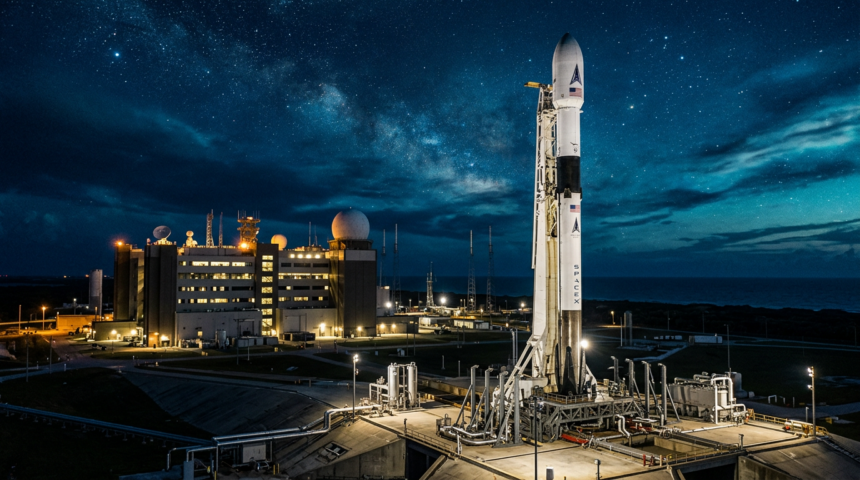
The Space Force is paying SpaceX $1.6B for 18 rides to orbit, its biggest single order yet under the National Security Space Launch Phase 3 program. All of the Falcon 9 missions will lift off from Vandenberg Space Force Base by the end of 2027 to stock the service’s sensing and targeting constellation.
The two task orders cover a portfolio that spans missile-warning spacecraft, a laser-linked military data relay and satellites built to spot moving targets on the ground. Together they are meant to give commanders a near real-time picture of threats, from inbound missiles to aircraft on the move.
Trucking company and builder
The award cements SpaceX as both the launch provider and a major builder for the constellation. It is already under contract for the Space Data Network Backbone, an optical communications network worth $2.29B, and the $4.16B Space-Based Airborne Moving Target Indicator system. Its Falcon 9s also carry the Space Development Agency’s Tracking Layer, infrared spacecraft that detect and follow missile threats.
One launch a month
Keep that schedule and SpaceX needs to fly from its California pad roughly once a month. Seven firms hold spots on the Lane 1 contract vehicle, but only SpaceX currently combines the flight rate, ready Falcon 9 fleet and West Coast infrastructure to deliver.
Col. Eric Zarybnisky, the Space Force’s acting acquisition executive for space access, pointed to the roughly two months it took from requirement to award as proof the streamlined Lane 1 process works. The deal lands weeks after the service nearly tripled the Lane 1 ceiling to $17B, a sign military launch demand is outstripping earlier forecasts.