

Space Security News
  • Home
  • News

    Unnamed defense customers reserve payload room on Dream Chaser’s first flight

    September 5, 2026

    Chinese satellite in a rare retrograde orbit leaves 43 tracked fragments

    September 5, 2026

    France’s space summit loses its US heavyweights over White House warnings

    September 5, 2026

    The Space Force changes commanders as Schiess pledges deliberate growth

    September 5, 2026
  • Features

    Darknavy claims full control of the newest Starlink terminals

    September 3, 2026

    Allied radar net watching geostationary orbit gains Wales outpost

    September 3, 2026

    Royal Air Force promotes space to a top-tier command role

    September 3, 2026

    Pentagon pays space suppliers to scale output ahead of a fleet boom

    September 3, 2026
  • Spotlight
  • Events
  • About Us
    • Mission
    • Services
    • Contact Us
Reading: Think tank calls debris-making ASAT tests a losing trade
Share
Search
  • Trending:
  • Alliances
  • Cislunar
  • Commercial
  • Communications
  • Cyber
  • Debris
  • Defense
  • Deterrence
  • Intelligence
  • Launch
  • Strategy
  • Surveillance
  • Missile
  • Navigation
  • War
Font ResizerAa
Space Security NewsSpace Security News
  • Home
  • News
  • Features
  • Spotlight
  • Events
  • About Us
Search
  • Home
  • News
  • Features
  • Spotlight
  • Events
  • About Us
    • Mission
    • Services
    • Contact Us
Follow US
© 2026 Space Security News. All Rights Reserved.
Features

Think tank calls debris-making ASAT tests a losing trade

FAS analysis argues debris-creating anti-satellite tests offer little military value and should be banned.

By
SSN Staff
Last updated: August 13, 2026
2 Min Read
Share

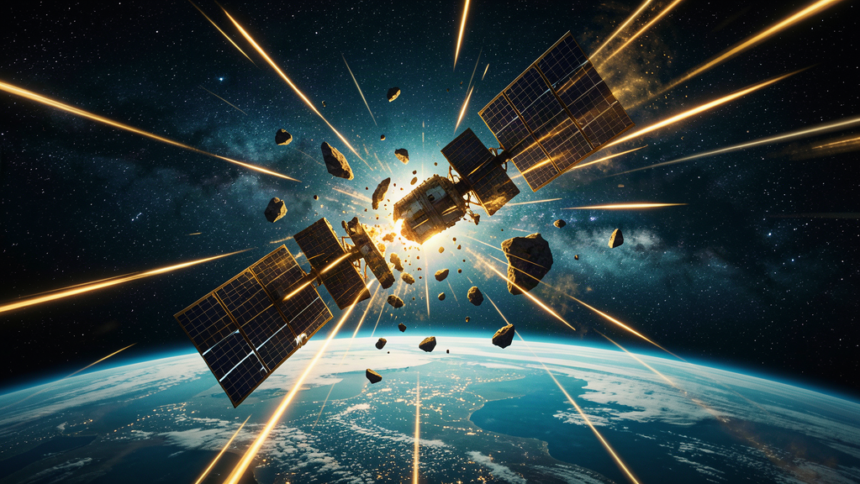
Nations that shoot down their own satellites get little military payoff for the debris they create, and the Federation of American Scientists wants a ban on such tests.

The think tank made the case in an Aug. 13 analysis by Matt Korda and Nivedita Raju, arguing that debris-creating direct-ascent anti-satellite tests score low on strategic and military benefits even though they carry enormous collision risk. More than 1.2 million pieces of debris larger than a centimeter now circle the Earth, and a relative handful of ASAT tests by the United States, Russia, China and India account for an outsized share of trackable junk.

The essay lands as UN space security talks weigh the issue. July’s session in Geneva saw constructive exchanges but deep divisions: some delegations pushed for a legally binding ban on destructive ASAT tests, while others argued that regulating tests alone misses development, deployment and use of other space weapons.

The central obstacle is missile defense. Interceptors and direct-ascent ASAT weapons share rocket motors, guidance and payload technology, so states fear that restricting the one handcuffs the other. FAS argues that overlap is overstated, because debris-creating tests offer limited military utility, and that the two mission sets can be decoupled in policy.

The authors recommend that states commit to banning debris-creating ASAT tests outright, treating the debris risk to satellite infrastructure, communications and nuclear command and control as the decisive factor.
TAGGED:anti-satellite weaponsASAT testsFASspace debrisspace policyUnited Nations
SOURCES:Federation of American Scientists

Sign Up For Daily Newsletter

Be keep up! Get the latest breaking news delivered straight to your inbox.
By signing up, you agree to our Terms of Use and acknowledge the data practices in our Privacy Policy. You may unsubscribe at any time.
Share This Article
Facebook Email Copy Link Print

LATEST NEWS

Unnamed defense customers reserve payload room on Dream Chaser’s first flight

News
September 5, 2026

Chinese satellite in a rare retrograde orbit leaves 43 tracked fragments

US tracking counts 43 fragments after a Chinese satellite in a rare retrograde orbit breaks…

September 5, 2026

France’s space summit loses its US heavyweights over White House warnings

SpaceX and Blue Origin lead US withdrawals from Macron's summit after Washington advises firms to…

September 5, 2026

The Space Force changes commanders as Schiess pledges deliberate growth

Gen. Douglas Schiess succeeds Chance Saltzman as chief of space operations with growth and deterrence…

September 5, 2026

YOU MAY ALSO LIKE

Space warfare’s new rules emerge from Ukraine and the Iran conflict

A former US arms control official distills the space lessons of Ukraine and the 2026 Iran conflict.

Policy, Law & Governance
August 3, 2026

Israel’s space budget adds weapons to strike Earth from orbit

Israel will fund offensive space systems to shield its satellites and strike targets on Earth from orbit.

News
August 24, 2026

MITRE releases emb3d™ – a cybersecurity threat model for embedded devices

Satellites are embedded systems wrapped in radiation-hardened armor. When MITRE releases a threat model for embedded devices, it matters directly…

FeaturesSatellite Security
May 12, 2026

New White House policy targets America’s launch bottleneck

Trump signed NSPM-17 to expand launch ranges, speed permits and grow commercial space transportation.

Policy, Law & Governance
August 21, 2026

Breaking developments in space and cybersecurity, decoded for the modern defense and technology landscape.

Follow us: 

  • News
  • Features
  • Spotlight
  • Events
  • About Us
  • Mission
  • Services
  • Contact Us
Copyright © 2026 Space Security News. All Rights Reserved.
Privacy Policy | Legal
Welcome Back!

Sign in to your account

Username or Email Address
Password

Lost your password?