

Space Security News
  • Home
  • News

    Ukrainian cyber operation exposes Russia’s missile and space design institute

    September 10, 2026

    TrustPoint books 40 spacecraft to scale its GPS-free navigation net

    September 10, 2026

    Simulators let guardians rehearse satellite combat without risking the fleet

    September 10, 2026

    Pentagon nearly doubles national security launch buys as bill hits $76B

    September 9, 2026
  • Features

    First live-fly space exercise puts real satellites through orbital agility drills

    September 9, 2026

    US war game ends with two rival missile shields and no deal

    September 9, 2026

    Britain folds space defense and civil work into one £7.8B plan

    September 9, 2026

    Bundeswehr scouts jammers and spoofers to counter Russian satellites

    September 7, 2026
  • Spotlight
  • Events
  • About Us
    • Mission
    • Services
    • Contact Us
Reading: A continuing resolution freezes more than money — it freezes vulnerabilities
Share
Search
  • Trending:
  • Alliances
  • Cislunar
  • Commercial
  • Communications
  • Cyber
  • Debris
  • Defense
  • Deterrence
  • Intelligence
  • Launch
  • Strategy
  • Surveillance
  • Missile
  • Navigation
  • War
Font ResizerAa
Space Security NewsSpace Security News
  • Home
  • News
  • Features
  • Spotlight
  • Events
  • About Us
Search
  • Home
  • News
  • Features
  • Spotlight
  • Events
  • About Us
    • Mission
    • Services
    • Contact Us
Follow US
© 2026 Space Security News. All Rights Reserved.
NewsSatellite Security

A continuing resolution freezes more than money — it freezes vulnerabilities

By
SSN Staff
Last updated: May 14, 2026
4 Min Read
Share
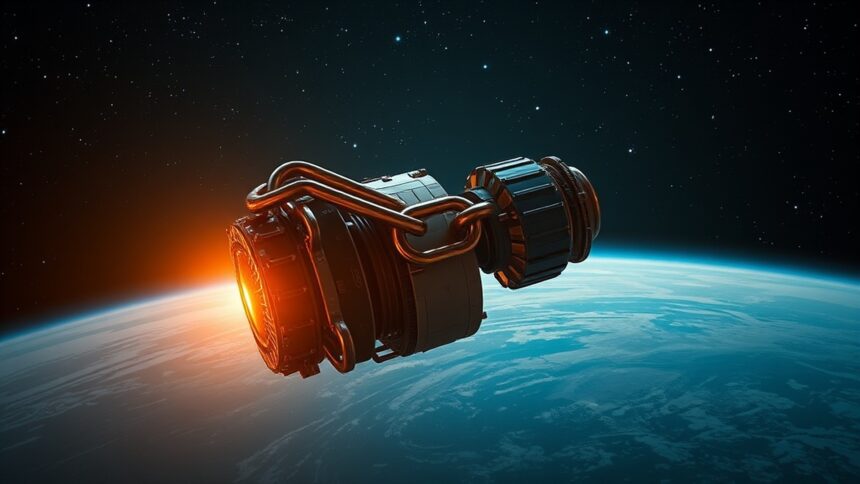
Space Force satellite with chain symbolizing budget freeze

A continuing resolution doesn’t just freeze money — it freezes vulnerabilities. While Congress debates the defense budget, the Space Force’s cybersecurity modernization sits in limbo, and adversaries are not waiting.

Contents
  • The Cybersecurity Spending Gap
  • Hiring Freezes = Security Gaps
  • The Real Cost Is Dwell Time

The math is stark: the White House proposed $70 billion for the Space Force. A continuing resolution (CR) would lock it at roughly $28 billion — last year’s level. That’s not just a funding gap. It’s a security gap.

Under a CR, the Space Force can’t start new programs without special approval. That means no new resilient satellite constellations, no accelerated missile warning upgrades, and critically, no new cybersecurity initiatives. Every unfunded cyber program is a hole that stays open while Russia and China continue testing anti-satellite weapons, co-orbital threats, and electronic warfare systems designed to blind, spoof, or hijack American space assets.

The Cybersecurity Spending Gap

Cybersecurity in space isn’t a one-time purchase — it’s a continuous process of patching, monitoring, and upgrading. Budget uncertainty breaks that cycle. When funding is frozen, satellite operators can’t invest in post-quantum cryptography upgrades. They can’t deploy intrusion detection systems for spacecraft. They can’t harden ground segment networks against supply chain attacks.

And the threats are accelerating faster than the funding. China has demonstrated co-orbital satellite inspection — a capability that sits directly on the border between routine maneuver and offensive cyber-physical attack. Russia has tested direct-ascent anti-satellite missiles that create debris fields, but the quieter threat is electronic warfare: jamming, signal spoofing, and cyber intrusions into satellite command-and-control links.

“The Space Force is locked, loaded, and prepared,” retired Maj. Gen. Thomas Taverney says of the proposed budget — but that preparation only goes as far as the funding allows. A CR doesn’t just delay new hardware. It stalls the cybersecurity workforce, freezes hiring for defensive cyber operators, and prevents long-term contracts for secure satellite communications.

Hiring Freezes = Security Gaps

The Space Force needs to grow its cybersecurity workforce to handle new threats. A CR caps hiring at current levels, leaving critical gaps in an already stretched team. Cyber operators, threat analysts, and red-team evaluators are hard to hire even with a full budget. Under a freeze, those slots stay empty while adversaries expand their capabilities.

There’s also the planning paralysis. CRs are temporary by design, so the Space Force can’t commit to multi-year security contracts or enterprise license agreements for defensive tools. Meanwhile, inflation erodes buying power, and every month under a CR means less money for the same security products.

The Real Cost Is Dwell Time

In cybersecurity, victory often goes to whoever has the shortest dwell time — the window between initial compromise and detection. Budget delays extend that window. When cyber programs are unfunded or delayed, threat actors have more time to burrow into networks, establish persistence, and move laterally across space systems.

While Congress dithers, China and Russia are testing direct-ascent anti-satellite weapons, co-orbital threats, and even nuclear-armed space-based systems. Hypersonic glide vehicles can strike from anywhere. But the more insidious threat is the one that doesn’t make a kinetic impact — the silent compromise of satellite communications, the exfiltration of telemetry data, the injection of malicious commands into spacecraft control systems.

Failing to pass a defense budget isn’t just a procedural failure. It’s a cybersecurity vulnerability that adversaries will exploit. The Space Force has a plan. Congress needs to fund it — before the gap between budget and threat becomes a gap in space superiority.

Sign Up For Daily Newsletter

Be keep up! Get the latest breaking news delivered straight to your inbox.
By signing up, you agree to our Terms of Use and acknowledge the data practices in our Privacy Policy. You may unsubscribe at any time.
Share This Article
Facebook Email Copy Link Print

LATEST NEWS

Ukrainian cyber operation exposes Russia’s missile and space design institute

Emerging Threats & Tech
September 10, 2026

TrustPoint books 40 spacecraft to scale its GPS-free navigation net

TrustPoint has ordered 40 spacecraft from EnduroSat's U.S. arm to scale up a C-band navigation…

September 10, 2026

Simulators let guardians rehearse satellite combat without risking the fleet

The Space Force is buying portable simulators so satellite crews can rehearse jamming and interference…

September 10, 2026

Pentagon nearly doubles national security launch buys as bill hits $76B

A fresh Pentagon cost report shows the US military planning 337 rocket launches versus 151…

September 9, 2026

YOU MAY ALSO LIKE

Rheinmetall and Space Norway merge radar bands for sea surveillance

The German defense giant and Norway's satellite operator will fuse radar bands for maritime awareness.

News
August 19, 2026

Space Force launches enlisted bonus pilot program

The US Space Force launched a pilot program offering targeted retention bonuses to enlisted Guardians in critical cyber and space…

NewsSatellite SecurityThreat Actors & Incidents
July 18, 2026

Airbus acquires Quarkslab — a sovereign cyber play takes shape in Europe

Airbus has acquired French cybersecurity firm Quarkslab in a move that consolidates European sovereign cyber capabilities across aerospace and defense.

FeaturesSatellite Security
May 16, 2026

Johns Hopkins APL to steer Space Force’s space-based interceptor program

The Space Force has selected Johns Hopkins University's Applied Physics Laboratory as technical direction agent for its space-based interceptor program.

News
August 2, 2026

Breaking developments in space and cybersecurity, decoded for the modern defense and technology landscape.

Follow us: 

  • News
  • Features
  • Spotlight
  • Events
  • About Us
  • Mission
  • Services
  • Contact Us
Copyright © 2026 Space Security News. All Rights Reserved.
Privacy Policy | Legal
Welcome Back!

Sign in to your account

Username or Email Address
Password

Lost your password?