

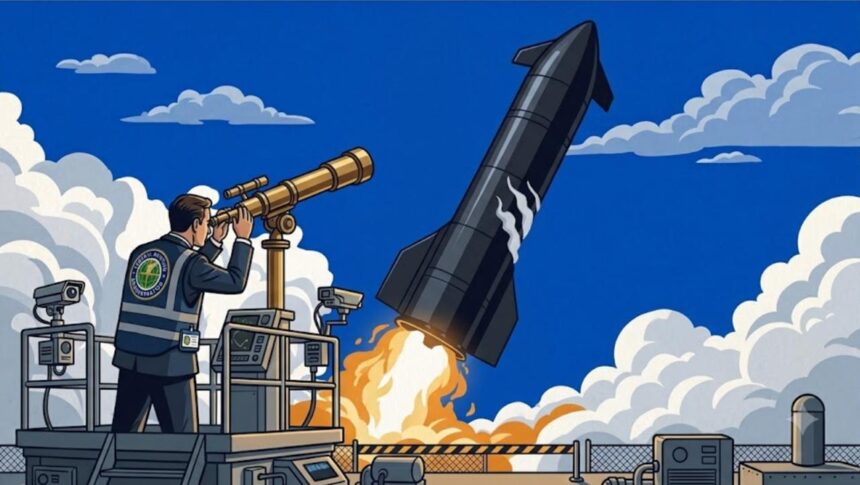
The Federal Aviation Administration has formally classified SpaceX’s May 22 Starship Flight 12 launch as a mishap, grounding the vehicle pending a full investigation into the failure of the Super Heavy booster during its return maneuver.
Regulatory Action and Investigation Requirements
In a May 27 statement, the FAA confirmed that the launch from Starbase, Texas, met the agency’s criteria for a mishap, specifically citing the failure to complete a planned reentry or landing. The incident centers on the Super Heavy booster, which experienced multiple engine failures shortly after stage separation.
SpaceX had intended to execute a boostback burn to guide the booster toward a soft splashdown in the Gulf of America. However, telemetry from the company’s webcast shows the burn ended after less than 20 seconds, far short of its planned one-minute duration. The booster subsequently impacted the Gulf at approximately 1,500 kilometers per hour.
The FAA has now mandated that SpaceX conduct a mishap investigation under agency oversight, requiring identification of root causes and corrective actions. The FAA must approve the final report before Starship can resume flight operations.
Technical Setbacks Amid First Flight of Upgraded Hardware
Flight 12 marked the debut of Starship version 3, featuring the new Raptor 3 engines with simplified design and increased thrust. Despite the booster failure, SpaceX achieved several test objectives, including deploying Starlink mass simulators in orbit and a controlled splashdown of the upper stage in the Indian Ocean.
Additional anomalies included the early shutdown of one Raptor engine on the Super Heavy during ascent and one engine on the upper stage. While the mishap classification formally grounds Starship, SpaceX would likely have conducted its own internal investigation before any subsequent launch, given the scale of the technical issues.
Precedent and Industry Context
The FAA’s mishap investigation process is not necessarily protracted. A recent precedent involves Blue Origin’s New Glenn launch on April 19, where an upper-stage malfunction stranded its payload in an unrecoverable orbit. The FAA accepted Blue Origin’s investigation report on May 22 and cleared the vehicle for return to flight.
Blue Origin subsequently announced on May 27 that its next New Glenn mission, carrying 48 satellites for Amazon’s Project Kuiper, is planned as soon as June 4. This timeline demonstrates that rigorous mishap investigations can be completed efficiently when root causes are clearly identified and corrective actions are credible.
For SpaceX, the Starship grounding represents a regulatory pause on the company’s most ambitious launch vehicle program. The outcome of the investigation will not only determine the timeline for Flight 13 but also set a precedent for how the FAA handles failures of next-generation, fully reusable super-heavy launch systems.
— Originally reported by SpaceNews. Adapted and republished with editorial context for SpaceSecurityNews.