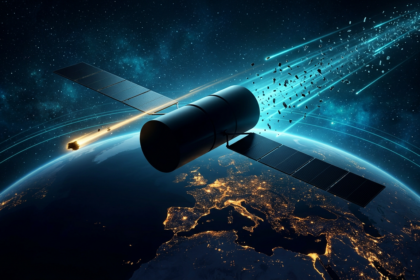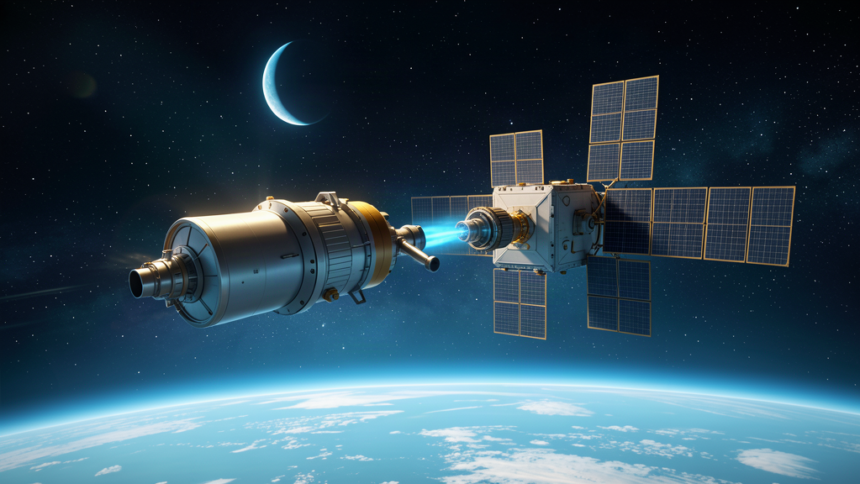
Chinese scientists say they topped up the fuel tank of a BeiDou navigation satellite in high orbit, a servicer-to-satellite propellant transfer that only a few programs have managed to pull off.
The transfer happened in February, according to the South China Morning Post, and reached peer review only recently through the Chinese Journal of Deep Space Exploration. A servicing craft docked with the navigation satellite and moved room-temperature fuel into its tanks.
Propellant is the clock on a navigation satellite’s life. Station-keeping, attitude control, orbit corrections and collision avoidance all draw on one limited supply. When it empties, working atomic clocks and transmitters become useless hardware, and an operator has to build and launch a replacement to keep the service intact.
Refueling changes that math. A single tanker could top up several satellites on one deployment, stretching the working lives of expensive spacecraft and easing the pressure to keep producing successors.
The maneuver is hard to pull off. A servicer has to match a target moving at kilometers per second, close to within centimeters without contact damage, then establish a mechanical or fluid connection and move propellant in microgravity without leaks, bubbles or contamination. Communications and navigation are trickier at those altitudes.
The capability carries military weight. Docking with your own satellite is indistinguishable, from the outside, from docking with someone else’s, and analysts have long warned that servicing technology transfers directly to co-orbital anti-satellite operations. The Space Force is funding its own refueling demonstrations for 2027.