

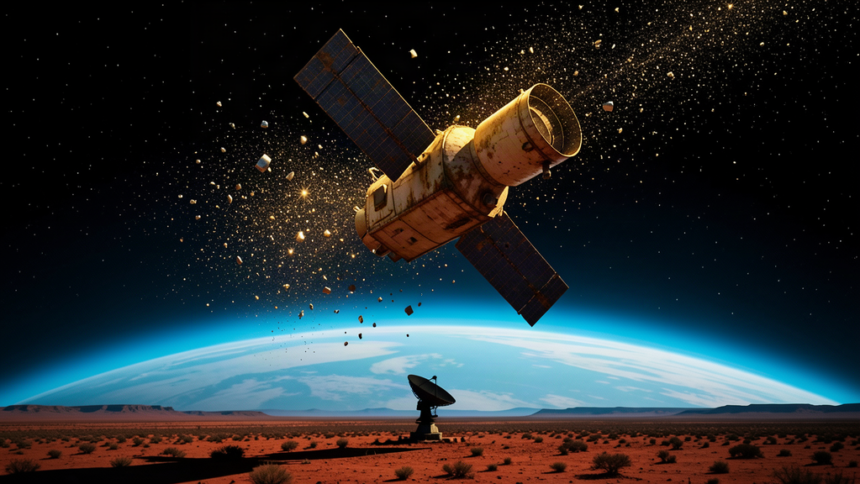
A Soviet weather satellite that had already died once kept its ability to cause trouble. Meteor 2-7 shed dozens of fragments in low Earth orbit on Oct 5, and the debris sits in a band where objects linger for centuries.
LeoLabs caught the event when the derelict spacecraft passed over its radar site in Western Australia. Further observations across its sensor network confirmed a debris-generating event, with tens of fragments posing a risk to nearby spacecraft.
A second breakup for an old wreck
Meteor 2-7 launched in May 1981, part of a Soviet series that monitored cloud cover and atmospheric conditions. It was deactivated decades ago. This was not its first fragmentation: debris expert Jim Shell dates an earlier breakup to March 2004. The main body still circles at roughly 855 kilometers, twice the altitude of the International Space Station.
Up there, the atmosphere is so thin it barely slows small objects. NASA estimates debris near 800 kilometers can stay in orbit for decades, and some analysts say centuries.
Why the cause may never be known
Two explanations fit. An internal malfunction may have destroyed the spacecraft, or something struck it. Shell leans toward a collision, but expects the cause will never be confirmed. The 855-kilometer belt is crowded, and at breakup the satellite sat near its highest latitude, where debris density peaks.
There is precedent for large clouds at that height. In 2007, China used a missile to destroy its Fengyun-1C weather satellite near 865 kilometers, scattering more than 3,000 trackable fragments.
LeoLabs framed the incident as the latest in a six-month series, including a March malfunction beside a Starlink satellite and an August Long March stage breakup. At roughly 28,000 kilometers per hour, even a centimeter of debris carries lethal energy.



