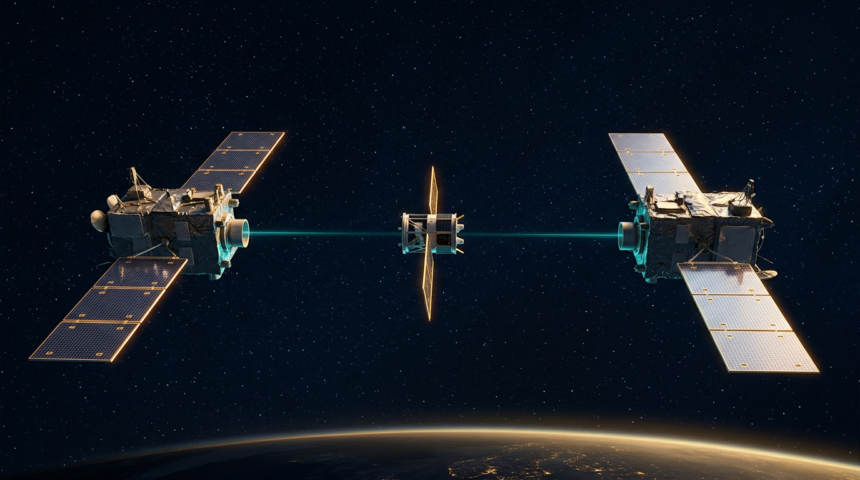
The Space Force’s most ambitious communications program has a language problem. The SpaceX-built laser terminals on the Space Data Network Backbone cannot trade data with the optical terminals on military missile-tracking satellites, so the service is planning a separate constellation whose only job is to convert between them.
Two laser families that cannot talk
Laser crosslinks move more data, faster and with less intercept risk than radio, which is why the backbone is built around them. But SpaceX is installing its own optical terminals, which it calls Plasers, and those do not interoperate with the terminals on Space Development Agency Tracking Layer satellites or Space Systems Command’s Resilient Missile Warning and Tracking satellites in medium Earth orbit. Sources told Breaking Defense the fix is roughly 12 or 13 Space Exchange Point satellites to sit between the waveforms. No public cost figure has been released, and the service has not confirmed the arrangement.
Why the gap matters for Golden Dome
The whole point of the Space Data Network is connecting sensors to shooters. If the backhaul layer speaks a different language than the tracking layer, the network does not close, and Golden Dome’s intercept timelines depend on that closure holding.
An operational prototype backbone is due in 2027. SpaceX won $2.29B in May to accelerate it toward the 2028 deadline. The concept is a restructured version of MILNET, which an official said last year would exceed 480 satellites.
Each vendor’s optical terminal is optimized for its own constellation, and no one owned the interface between them. The exchange point satellites, if funded, become the mediation layer for the whole architecture, which carries a resilience problem of its own. A translator that fails takes two networks down with it.