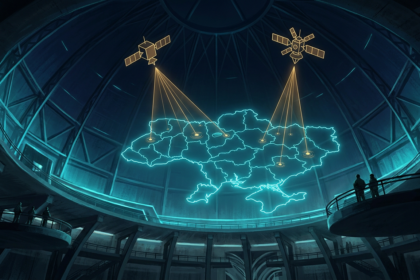
The Pentagon's top space communications official wants satellite defenses that keep working after the ground link goes dark. Mike Dean, who directs command, control and communications infrastructure for the Defense Department's chief information officer, told CyberSat in Reston, Virginia that adversaries are already using machine learning to hunt zero-day flaws in satellite flight software and fabricate fake telemetry. His answer is to put the defense onboard and let it act alone.
Why the ground link becomes the weak point
Most military cyber defense assumes a connection back to an operations center. That assumption fails in orbit, where bandwidth is scarce and an adversary's first move may be to cut the link entirely. Commercial security tools built for corporate networks do not survive that environment, Dean said. Instead, the department is designing satellite payloads to host AI-driven defense software directly, so a spacecraft can spot an intrusion, wall off the compromised subsystem, and reroute telemetry without waiting for orders from Earth.
Patching orbit in hours instead of months
Dean put hard numbers on the change he wants. Manual code audits and slow change-control boards are being replaced with continuous automated pipelines across the department, with the target of beaming a cryptographically signed patch to a satellite within hours.
He described testing candidate software against digital twins and cyber ranges loaded with the government's best nation-state exploitation tools before it reaches a launch pad, to find holes on the ground rather than in a contested orbit.
Dean tied the effort to a mandate rather than a preference. His office is requiring formal validation of cyber resilience across national security space systems, with what he called zero exceptions for space platforms. That raises the bar for contractors, who must show how a spacecraft behaves under attack, not only under ideal conditions.