Greece marked the launch of a Space Operations Command at Dekelia Air Base on November 9 by lodging satellite work with the military itself. Defence Minister Nikos Dendias inaugurated the unit and handed it a task: turning orbital imagery into usable operational intelligence.
His speech framed space as one theatre among several, braided into sea, air and land. Ukraine served as the cautionary case, a state whose satellite access vanished and whose comms took the hit.
From buying data to controlling the network
Communications drew the sharpest words, and Dendias was clear that no state in crisis should lean on a third-country private firm. Geostationary military telecom sits among the Long-Term Defence Equipment Programme’s priorities, and the national MILSATCOM push is meant to leave Athens controlling the satellite, its ground segment and the network on its own terms.
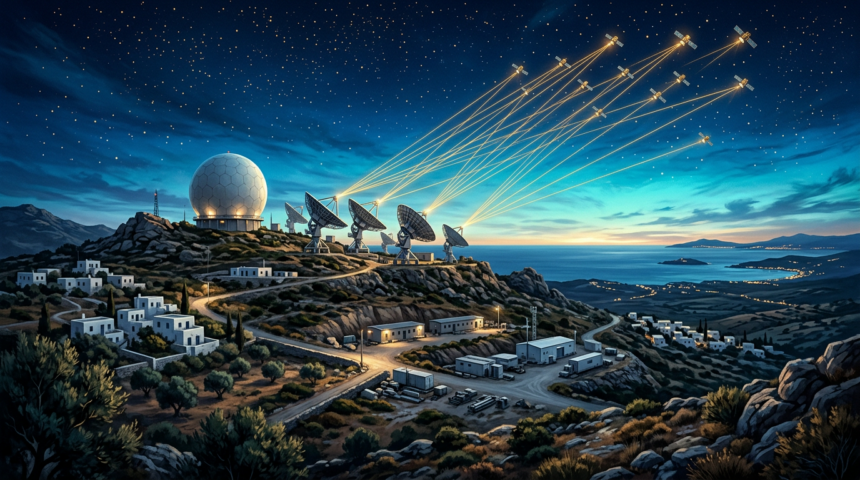
Ground sites carry the plan forward, with Tanagra home to the HELIOS-II station and Atalanti hosting a communications station. Brussels picked Attica as a GOVSATCOM hub.
A 2030 architecture for a 2026 command
Sixteen dual-use low-orbit optical satellites, secured with the Ministry of Digital Governance, already serve Greece, though Dendias judged the tally too small. He pressed for Greek ownership of the information itself, asking what minister could accept a 24-hour wait for a regional photograph bought abroad.
Architecture 2030 answers with twelve new spacecraft. Half observe optically; three run signals intercepts while the remainder carry synthetic aperture radar able to peer through fog.
A single structure now knots command and control to computing, cyber, collection, surveillance, reconnaissance and targeting, replacing the C4I design with C5 ISRT. Greece, Dendias insisted, is filling a gap other regional states already fill rather than pioneering.
General Dimitrios Houpis and Thanos Dokos attended, before the minister toured facilities and watched the operations centre run live.