
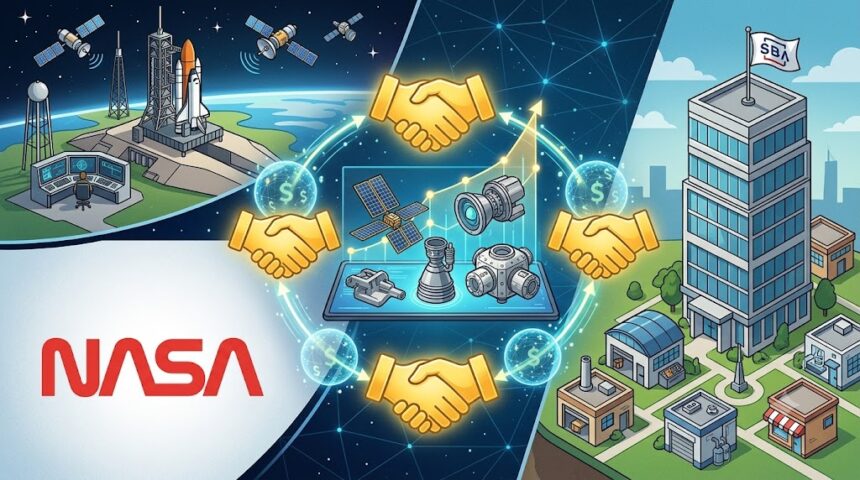
NASA and the U.S. Small Business Administration (SBA) have signed a formal agreement to steer private capital toward small companies developing critical space technologies, directly addressing supply chain vulnerabilities in the Artemis program and other national priorities. The partnership, formalized through a memorandum of agreement last week, leverages the SBA’s existing Small Business Investment Company (SBIC) program, which uses government-guaranteed loans to match private investment. Under the deal, participating SBIC funds must commit at least 60 percent of their capital to technology areas designated by NASA.
Strategic Focus Areas and Capital Alignment
NASA has identified seven initial “strategic aerospace technology focus areas” for the initiative: energy production, infrastructure and storage; nuclear power and propulsion; advanced software, avionics and communications systems; specialized materials and components; infrastructure for inhospitable environments; scaled launch infrastructure; and biomedical and life support technology. The agency’s new Office of Strategic Capital will manage the partnership, serving as a conduit to connect small businesses with funding opportunities rather than offering direct loans—a distinction from the Defense Department’s Office of Strategic Capital, which can provide up to $150 million in direct loans per project. SBA Administrator Kelly Loeffler stated that the effort is designed to “mobilize private sector investment to fuel the small businesses, manufacturers and innovators that are driving American space dominance.”
Industry Response and Supply Chain Context
The Aerospace Industries Association (AIA) welcomed the announcement, with President and CEO Eric Fanning calling it “exactly the kind of effort needed to maintain America’s leadership in space.” Fanning’s endorsement follows a March 2024 study by PricewaterhouseCoopers, commissioned by the AIA, which identified a fragile space industry supply base where demand is outstripping capacity. The study recommended targeted subsidies, incentives, and focused contract awards to help new suppliers cover the regulatory and compliance costs of entering government programs. “This initiative will reinforce the industrial base needed to take us back to the moon and unlock new discoveries, down to the smallest components,” Fanning added.
What This Means for the Space Industrial Base
The NASA-SBA partnership signals a deliberate shift toward using financial engineering—rather than direct government procurement—to de-risk and scale the space supply chain. By aligning private capital with agency-defined priorities, the initiative aims to reduce bottlenecks in everything from nuclear propulsion to biomedical life support, while avoiding the bureaucratic overhead of traditional grant programs. For the broader industry, this model may prove replicable across other federal agencies, offering a template for how government can catalyze investment in deep-tech manufacturing without assuming the full financial burden. The success of the effort will ultimately hinge on whether the SBIC program can attract sufficient fund managers willing to commit to NASA’s technology roadmaps—and whether those investments yield the production capacity the agency needs for its next lunar campaign.
— Originally reported by SpaceNews. Adapted and republished with editorial context for SpaceSecurityNews.