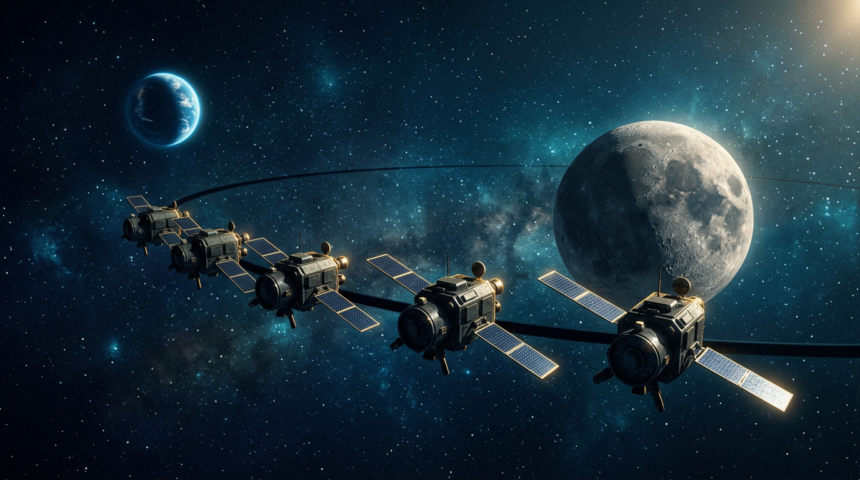
The Pentagon has asked industry to say whether it can put spacecraft near the Moon, opening the first formal solicitation for what the Air Force calls a Cislunar Space System. Responses are due November 24.
The request for information, issued November 2, describes up to five satellites, each carrying a government-furnished payload, meant to reach their posts by late 2029. The service will award fixed-price preliminary design studies rather than fund development.
A constellation grown from seed vehicles
Language in the notice calls the first five “seed vehicles” that would shape how a much larger fleet gets bought later. That framing turns a handful of demonstrations into the seed round of an acquisition program.
Today the Space Force’s farthest spacecraft sit in geostationary orbit, roughly 36,000 km out. Cislunar space offers no navigation grid, so each satellite must hold position against the competing pull of Earth and the Moon largely on its own. Contractors are being asked about propulsion for constant station-keeping, plus onboard computing and autonomy for long stretches without contact.
Why the timeline moved
Maj. Gen. Stephen Purdy, who runs advanced programs acquisition, has told industry the service wants hardware that already flies rather than a multi-year science effort. Officials have pointed to China’s plan to land astronauts before 2030 as the reason for urgency, and Gen. Dan Caine, the Joint Chiefs chairman, has said troops must prepare for conflict around the Moon.
Two single-satellite pathfinders are already in the pipeline. The Air Force Research Laboratory’s roughly $75M Oracle-Mission is to transit cislunar space and practice keeping custody of objects there, and Oracle-Prime would track satellites and debris from near the Earth-Moon L1 point.
The notice commits the government to nothing. Commercial builds run two to three years, so meeting 2029 likely means contracts signed in 2027.