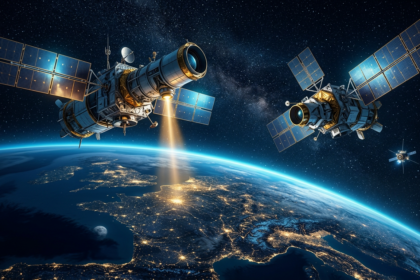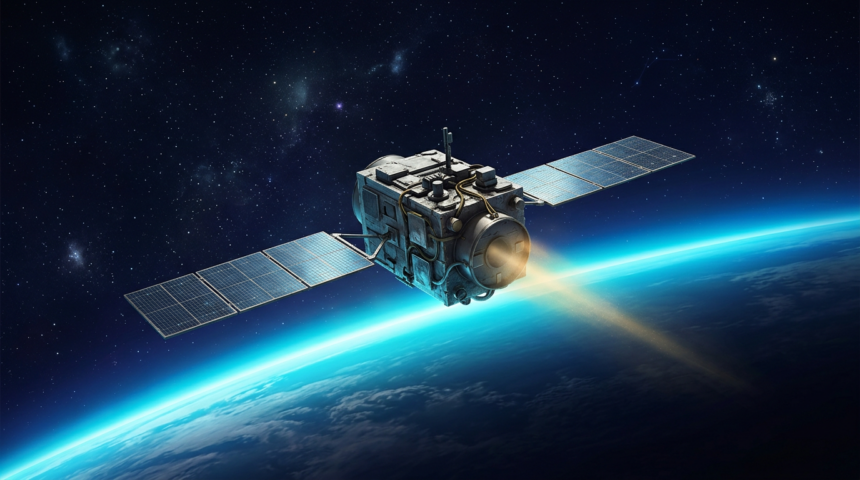
A satellite that skims the atmosphere at 200 kilometers cannot carry enough fuel to stay there. DARPA is betting it can instead harvest the thin air it flies through, and has paid a contractor to prove the idea in orbit.
A smaller spacecraft goes up first
The Defense Advanced Research Projects Agency awarded Redwire $20M to build and fly a scaled version of its SabreSat bus, a precursor step before committing to a full demonstration. Launch is targeted for late 2027, with the vehicle spending under a day in very low Earth orbit.
The short sortie is deliberate. Air-breathing electric propulsion has never run on orbit, so the subscale mission exists to gather data that ground chambers cannot reproduce. Redwire’s Spence Wise described the goal as reducing risk for the main flight rather than proving the whole system at once.
Why altitude is the prize
Flying between 90 and 250 kilometers buys sharper imagery, lower latency and cheaper launch mass. It also encounters drag strong enough to pull an ordinary spacecraft down within weeks unless something counteracts it.
The concept calls for collecting residual atmospheric gas, ionizing it and firing it out the back. That turns a hazard into propellant and, if it works, produces a spacecraft that maneuvers persistently without hauling its own reaction mass.
Maneuverability is the security argument
Redwire pitches the technology to national security customers on agility, not imagery. A satellite that shifts orbit cheaply and repeatedly is harder to predict and harder to hold at risk, and after two years of close-approach encounters in low orbit, the ability to move has become a defensive requirement in its own right.