

Space Security News
  • Home
  • News

    Vast recruits Slingshot co-founder to lead defense satellite push

    July 27, 2026

    Commerce department launches voluntary certification for novel space missions

    July 27, 2026
    Sentinel satellite overlooking the Strait of Hormuz shipping lanes

    EU halts Copernicus imagery release near Iran war zone

    July 27, 2026
    Military GPS satellite with encrypted signal beams in orbit

    Air Force seizes control of troubled jam-proof GPS receiver project

    July 27, 2026
  • Features

    Classified Chinese satellite sweeps the geostationary belt for threats

    July 24, 2026

    Japan’s JAXA tests reusable rocket RV-X in milestone for space infrastructure

    July 24, 2026

    Software-defined radios open new attack surface for satellite networks

    July 22, 2026

    GPS jamming wave pushes UK toward self-reliant satellite security

    July 21, 2026
  • Spotlight
  • Events
  • About Us
    • Mission
    • Services
    • Contact Us
Reading: Quantum Computing Is About to Become a National Security Problem in Orbit
Share
Search
  • Trending:
  • Alliances
  • Cislunar
  • Commercial
  • Communications
  • Cyber
  • Debris
  • Defense
  • Deterrence
  • Intelligence
  • Launch
  • Strategy
  • Surveillance
  • Missile
  • Navigation
  • War
Font ResizerAa
Space Security NewsSpace Security News
  • Home
  • News
  • Features
  • Spotlight
  • Events
  • About Us
Search
  • Home
  • News
  • Features
  • Spotlight
  • Events
  • About Us
    • Mission
    • Services
    • Contact Us
Follow US
© 2026 Space Security News. All Rights Reserved.
Emerging Threats & Tech

Quantum Computing Is About to Become a National Security Problem in Orbit

By
SSN Staff
Last updated: June 29, 2026
4 Min Read
Share

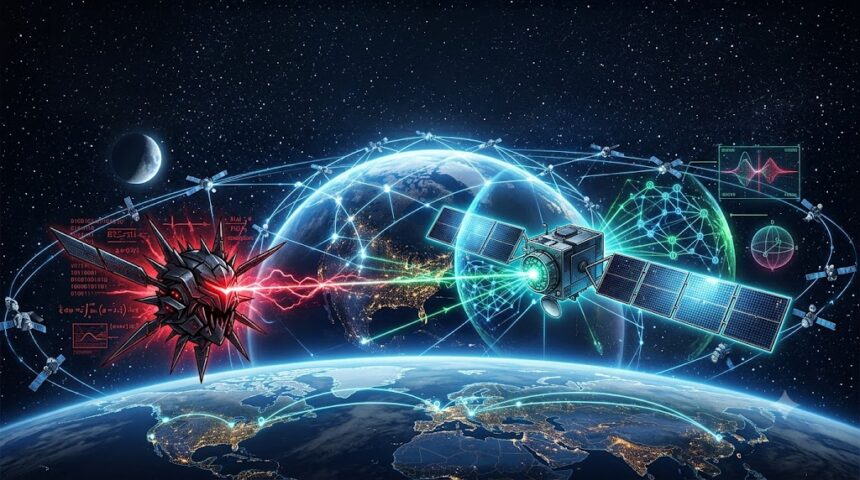
Quantum computing’s projected arrival by 2029 threatens to dismantle the cryptographic foundations securing satellite communications, command links, and mission data, forcing the commercial space industry to treat quantum resilience as an urgent mission assurance imperative rather than a distant cybersecurity concern.

Contents
  • The Threat Is Already Active
  • Active Surveillance and Data Manipulation
  • Gray-Zone Operations and Invisible Compromise
  • The Path Forward: Crypto-Agility Over Inventory

The Threat Is Already Active

The most dangerous misconception among satellite operators is that quantum threats begin only when a cryptographically relevant machine goes online. In reality, adversarial intelligence agencies are already conducting “harvest now, decrypt later” operations, capturing encrypted satellite telemetry, command traffic, and system designs today for future decryption.

For space companies, this exposure is uniquely long-lived. Satellite architectures, sensor designs, and government program data retain strategic value for decades, far exceeding the operational lifespan of any single LEO spacecraft. Information intercepted today will remain valuable when quantum capabilities mature, and once captured, no future cryptographic patch can retroactively protect it.

Active Surveillance and Data Manipulation

When nation-states field cryptographically relevant quantum computers, the threat escalates from passive collection to active, real-time surveillance. Encryption protecting communications, telemetry, and command links could be broken in near-real time, allowing adversaries to monitor constellation health, track asset tasking, and map command patterns across entire fleets.

The more insidious threat, however, is data manipulation. Quantum-enabled adversaries could forge telemetry, alter command authentication, and inject false tracking data without triggering standard security alerts. Mission operations teams depend on authentic telemetry for maneuver planning and collision avoidance; corrupted data could induce operators to hold necessary maneuvers or execute dangerous ones, particularly dangerous in an orbital environment with over 18,000 active satellites and millions of debris fragments.

Gray-Zone Operations and Invisible Compromise

Quantum attacks are ideally suited for gray-zone competition precisely because the operator may never detect the compromise. Unlike proximity operations or conventional cyberattacks, quantum-forged data passes authentication checks as legitimate, making it nearly invisible to standard monitoring tools.

This invisibility serves the strategic objective of manufacturing uncertainty rather than causing physical damage. If satellite data and communications can no longer be trusted, that uncertainty cascades into every downstream decision—from defense customers receiving false missile warnings to commodity markets moved by corrupted crop data. The difficulty of attribution further complicates deterrence, raising the likelihood that state actors will weaponize these capabilities against the commercial space sector.

The Path Forward: Crypto-Agility Over Inventory

The industry’s critical liability is that spacecraft and ground systems rely on infrastructure that cannot be replaced quickly. Operators must prioritize architectural crypto-agility—the ability to swap cryptographic algorithms without hardware changes or network downtime—rather than spending months cataloging every dependency before taking protective action.

With crypto-agility in place, operators can migrate newly discovered dependencies as needed rather than forcing system redesigns. The immediate next steps are adopting finalized NIST post-quantum standards and aligning with NSA’s CNSA 2.0 timeline. For an industry whose systems carry strategic value across decades, the window to prepare is closing. Quantum computing will not announce its arrival; it will simply make today’s encrypted data permanently transparent.

— Originally reported by SpaceNews. Adapted and republished with editorial context for SpaceSecurityNews.


Sign Up For Daily Newsletter

Be keep up! Get the latest breaking news delivered straight to your inbox.
By signing up, you agree to our Terms of Use and acknowledge the data practices in our Privacy Policy. You may unsubscribe at any time.
Share This Article
Facebook Email Copy Link Print

LATEST NEWS

Vast recruits Slingshot co-founder to lead defense satellite push

News
July 27, 2026

Commerce department launches voluntary certification for novel space missions

The Office of Space Commerce rolls out a voluntary certification system for novel space activities…

July 27, 2026
Sentinel satellite overlooking the Strait of Hormuz shipping lanes

EU halts Copernicus imagery release near Iran war zone

The EU imposed a 24-hour restriction on Sentinel satellite imagery of the Gulf of Oman…

July 27, 2026
Military GPS satellite with encrypted signal beams in orbit

Air Force seizes control of troubled jam-proof GPS receiver project

The Air Force absorbed the Pentagon's M-code GPS receiver program from the Space Force after…

July 27, 2026

YOU MAY ALSO LIKE

OrbitWhisperer AI Satellite Cybersecurity Framework Presented to NATO

A new AI-driven satellite resilience framework developed by Embry-Riddle researchers is drawing international attention after being presented to NATO. OrbitWhisperer…

Emerging Threats & TechSatellite Security
June 25, 2026

Space cybersecurity leaders convene in Singapore for inaugural CYSAT Asia

The inaugural CYSAT Asia conference convened in Singapore this week, gathering senior cybersecurity leaders from across the global space industry…

Emerging Threats & TechEvents
February 6, 2026

NSA reveals details of new LEO security report

The US National Security Agency just dropped a new playbook for securing the internet's fastest-growing frontier: low Earth orbit satellites.

Emerging Threats & TechFeatures
May 13, 2026

Indian Space-Tech Startup QOSMIC Raises $3.3M for Optical Communication Infrastructure

QOSMIC, an Indian space-tech startup building optical communication infrastructure for space, has secured $3.3 million in seed funding to accelerate…

Emerging Threats & Tech
July 2, 2026

Breaking developments in space and cybersecurity, decoded for the modern defense and technology landscape.

Follow us: 

  • News
  • Features
  • Spotlight
  • Events
  • About Us
  • Mission
  • Services
  • Contact Us
Copyright © 2026 Space Security News. All Rights Reserved.
Privacy Policy | Legal
Welcome Back!

Sign in to your account

Username or Email Address
Password

Lost your password?