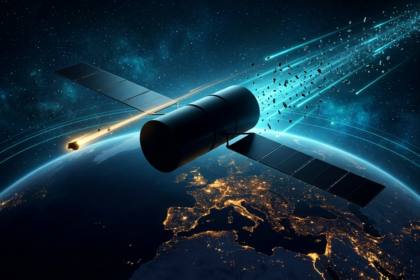

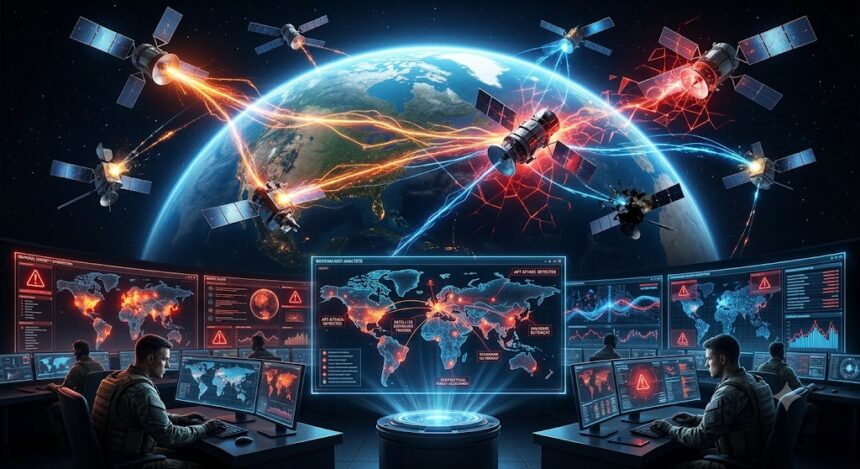
The global space industry is experiencing a dramatic escalation in cyber threats following recent military operations involving Iran, with security experts reporting a 400% increase in cyberattack activity targeting satellite operators, aerospace organizations, and related infrastructure.
The warning came during a CyberSat webinar focused on evolving threats to space systems, where cybersecurity professionals highlighted a significant shift in both the volume and sophistication of attacks against the sector.
Cyber Activity Reaches New Levels
According to cybersecurity leaders participating in the discussion, attack activity affecting space-related organizations has risen sharply compared to pre-conflict levels.
While geopolitical crises have historically triggered increases in cyberattacks, experts noted that the current environment is characterized by a closer convergence between nation-state actors and hacktivist groups. This combination has created a more persistent and coordinated threat landscape for organizations operating within the aerospace and space sectors.
Researchers say the trend resembles cyber activity observed during previous geopolitical conflicts, but with a greater emphasis on targeting defense contractors, industrial organizations, satellite operators, and critical infrastructure providers connected to the space ecosystem.
Iranian Threat Groups Expand Targeting
Security researchers have documented a noticeable evolution in Iranian cyber operations over the past year.
During recent regional conflicts, multiple groups reportedly conducted cyber campaigns against satellite communications providers, aerospace organizations, and government entities connected to space operations.
Among the organizations reportedly targeted were satellite communications providers and national space agencies across the Middle East. Researchers also observed personnel-focused operations, data theft campaigns, and attempts to compromise defense-sector organizations.
The attacks demonstrate how cyber operations are increasingly being used alongside traditional military activities, creating additional risks for organizations that rely on space-based technologies.
Artificial Intelligence Accelerates the Threat Landscape
Experts believe artificial intelligence is significantly contributing to the increased pace and sophistication of cyberattacks.
AI technologies are enabling threat actors to automate vulnerability discovery, generate malicious code more rapidly, scale phishing and social engineering campaigns, and improve operational efficiency.
The concern extends beyond established nation-state actors. AI tools have reduced technical barriers, allowing less sophisticated groups to conduct more advanced attacks than would have previously been possible.
At the same time, defenders are using AI to identify vulnerabilities, analyze telemetry data, detect anomalies, and strengthen cybersecurity monitoring capabilities.
This has created an increasingly competitive environment where both attackers and defenders are leveraging AI to gain an advantage.
Focus Shifts from Prevention to Resilience
Cybersecurity professionals participating in the discussion argued that organizations can no longer rely solely on traditional prevention-focused security strategies.
As AI-driven offensive capabilities continue to evolve, defenders face growing challenges in identifying and patching vulnerabilities before they can be exploited.
Instead, experts emphasized the importance of detection, containment, resilience, and rapid response capabilities.
The goal is increasingly becoming the ability to identify intrusions quickly, limit their impact, and maintain operational continuity rather than assuming all attacks can be prevented outright.
Ground Systems Remain the Primary Target
Despite concerns about spacecraft security, experts noted that attackers most often target ground-based infrastructure rather than satellites themselves.
Common attack vectors include:
- Identity and access management systems
- Cloud environments
- Third-party suppliers and service providers
- Corporate IT networks
- Remote access systems
- Software supply chains
Compromising these systems often provides attackers with easier and more reliable access than attempting to directly target spacecraft operating in orbit.
Researchers stressed that organizations should strengthen supply-chain visibility, implement Zero Trust architectures, enforce role-based access controls, and improve security awareness training throughout their workforce.
Growing Interest in On-Orbit Cybersecurity
Although attacks directly targeting spacecraft remain relatively uncommon, government agencies and researchers are increasingly investing in onboard cybersecurity capabilities.
New initiatives are exploring methods for detecting threats within satellites themselves, allowing operators to identify suspicious behavior and respond to potential compromises while systems remain in orbit.
However, experts acknowledge that visibility into space-based cyber incidents remains limited, making it difficult to determine whether direct attacks against spacecraft are rare or simply difficult to detect.
A New Era for Space Security
The recent surge in attacks underscores the growing strategic importance of space infrastructure and the increasing role cybersecurity plays in protecting it.
As governments, militaries, and commercial operators become more dependent on satellites for communications, navigation, intelligence, and critical services, cyber threats targeting the sector are expected to continue growing in both scale and sophistication.
For satellite operators and aerospace organizations, the challenge is no longer whether they will face cyber threats, but how effectively they can detect, contain, and recover from them in an environment where geopolitical tensions and AI-driven capabilities are reshaping the threat landscape.